
Percentage Uniform Marks (PUM) Explained: A Comprehensive Guide
Understanding your Cambridge International exam results can often feel like decoding a complex language. While your final letter grade (A*,



The marking and grading process of exam papers by Cambridge International Examinations (CIE) is a meticulous and standardized procedure designed to ensure fairness, accuracy, and consistency in evaluating student performance.
This guide provides an overview of how exam papers are assessed, from initial marking by examiners to the final grading decisions that determine students’ results. By understanding the key principles and methods employed by CIE, educators, students, and stakeholders can gain insight into how marks are awarded and grades are determined, ensuring confidence in the reliability of the examination system.
*If the video isn’t playing for you, please read below.
Most of the exam scripts are scanned and marked by the examiners on their computers. Other exam scripts are marked manually on paper. For the multiple-choice component, the computer automatically marks the papers.
Cambridge examiners are composed of teachers and subject experts. Their task is to mark the exam scripts at the same standard. This means all the examiners mark according to the mark scheme and they all apply the mark scheme in the same way.
A team of experienced senior examiners mark a sample set of exam scripts based on the mark scheme. They then agree to the marks. These same exam scripts set the standard and will be used by the other examiners to practice marking. This is to make sure that all examiners understand how to mark the same way. For the final part of calibration, they mark another set of scripts as a test. They then begin to start marking all other papers.
The senior examiners review all the markings of every examiner. This is to ensure that they are all marked correctly. If an examiner fails to mark consistently, another examiner remarks the scripts.
CIE uses grade boundaries to convert marks into grades. The grade boundaries are the minimum mark needed to achieve a grade. It considers statistical evidence and expert judgment to agree to grade boundary. It also accounts the slight difference in the level of difficulty every year.
When the grade boundaries are set, it is applied to marks for grading. The senior examiners carry out final checks on the markings and the results are then sent to the schools.
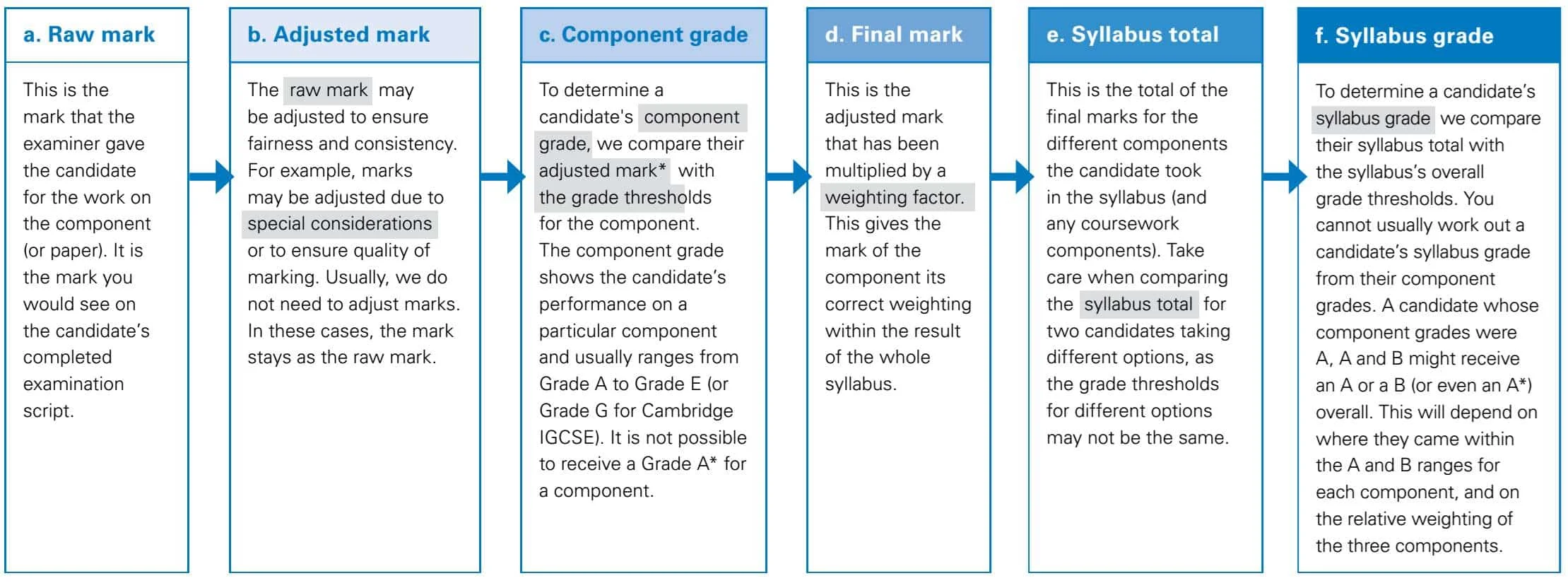
The raw mark is the sum of all the total marks achieved in that component.
The mark found on the candidate’s completed examination script is the raw mark. For example in Syllabus 0620, the candidate’s raw mark in Component 41 is 20 out of the 80 total marks available.
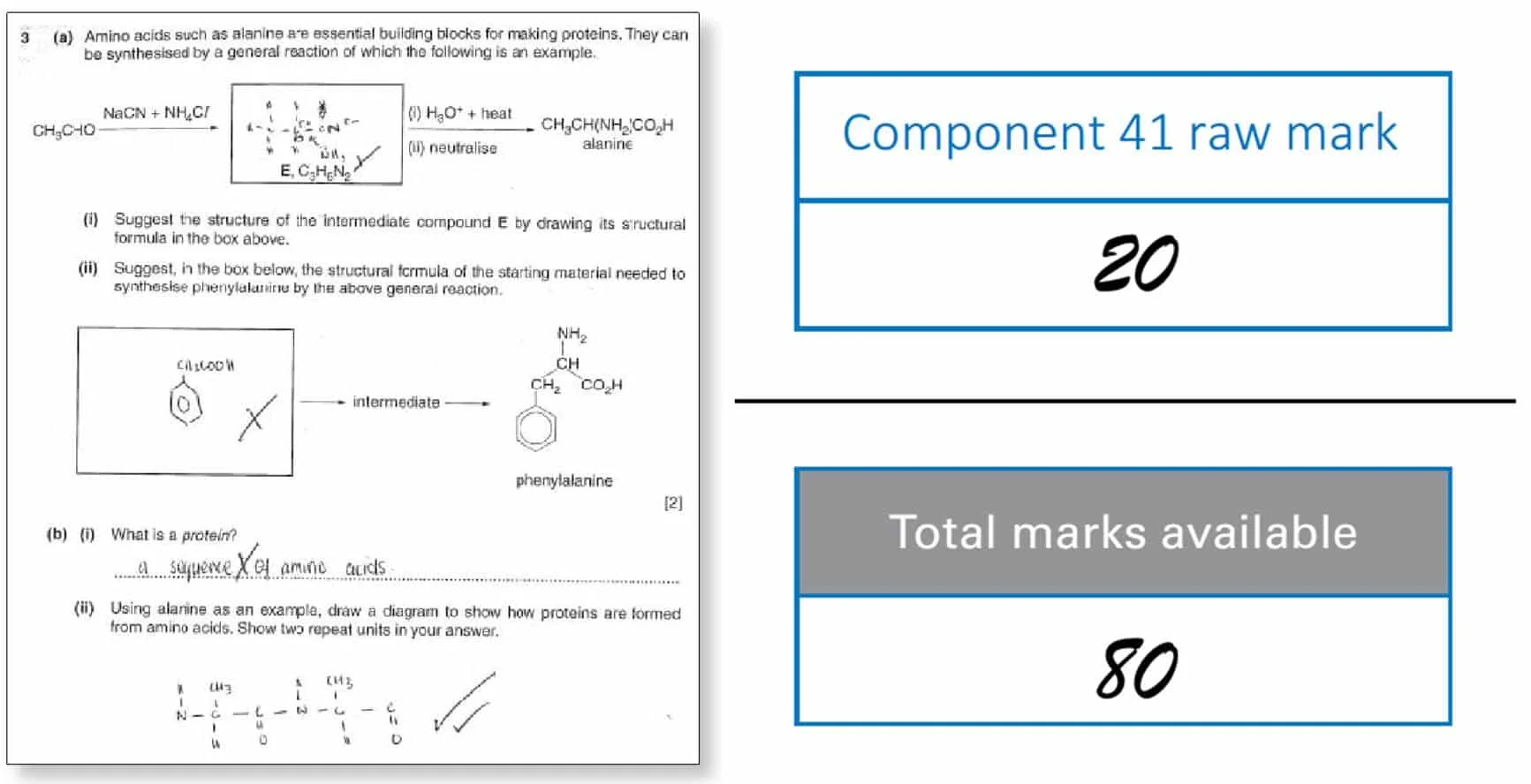
Raw marks are adjusted to ensure fairness and equality. It can be adjusted due to scaling, granting of special consideration or both. Scaling is applied to ensure consistency across the marking process and the different examiners. Special consideration is granted if CIE agrees to an earlier formal request from a Centre. Usually, there is no need to adjust marks and the mark stays as a raw mark.
For example, the candidate’s component 41 raw mark of 20 is adjusted to 21 to reflect the fairness and consistency of marking between examiners.

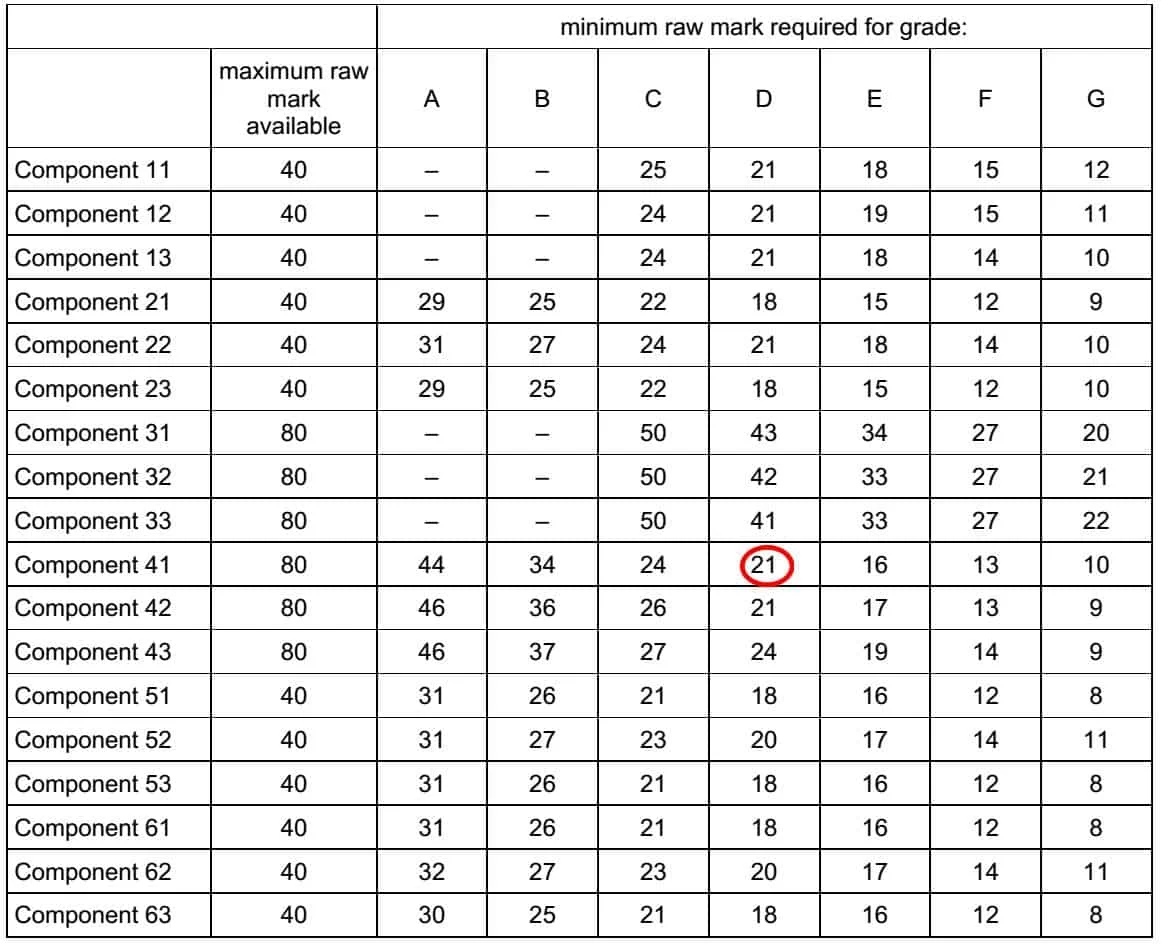
Compare the component’s raw mark with the component’s grade thresholds. The component grade can be found on the subject syllabus? Grade Threshold.
For example, the candidate’s component 41 adjusted mark is 21, its component grade falls under the grade D threshold.
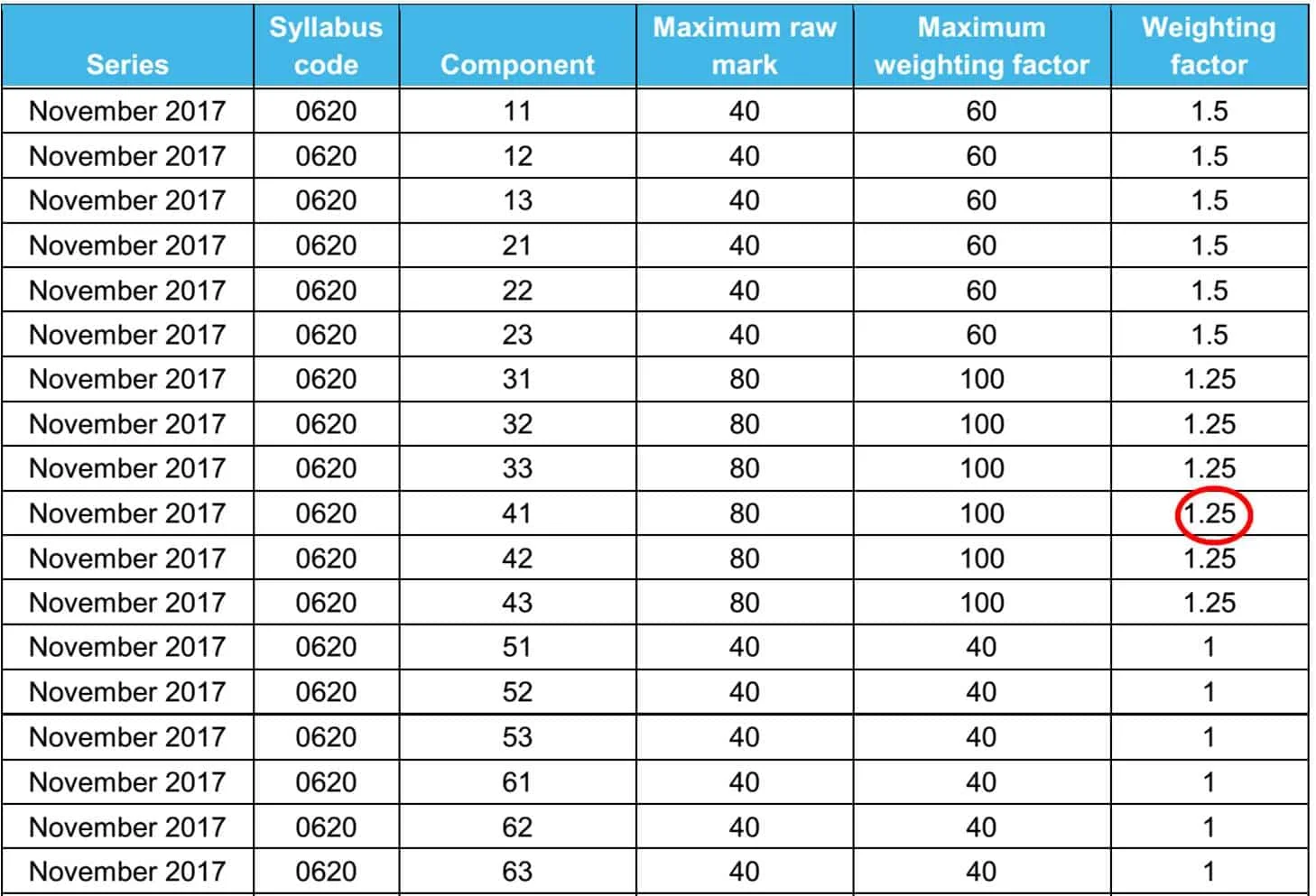
Calculate the final mark by multiplying each component’s mark by its weighting
factor. Weighting factor is the value assigned by CIE to indicate the level of importance of each component. The component weighting factors can be found here.
Calculate the syllabus total by adding all final marks together. Round up syllabus totals that end in 0.5 to the nearest whole number.
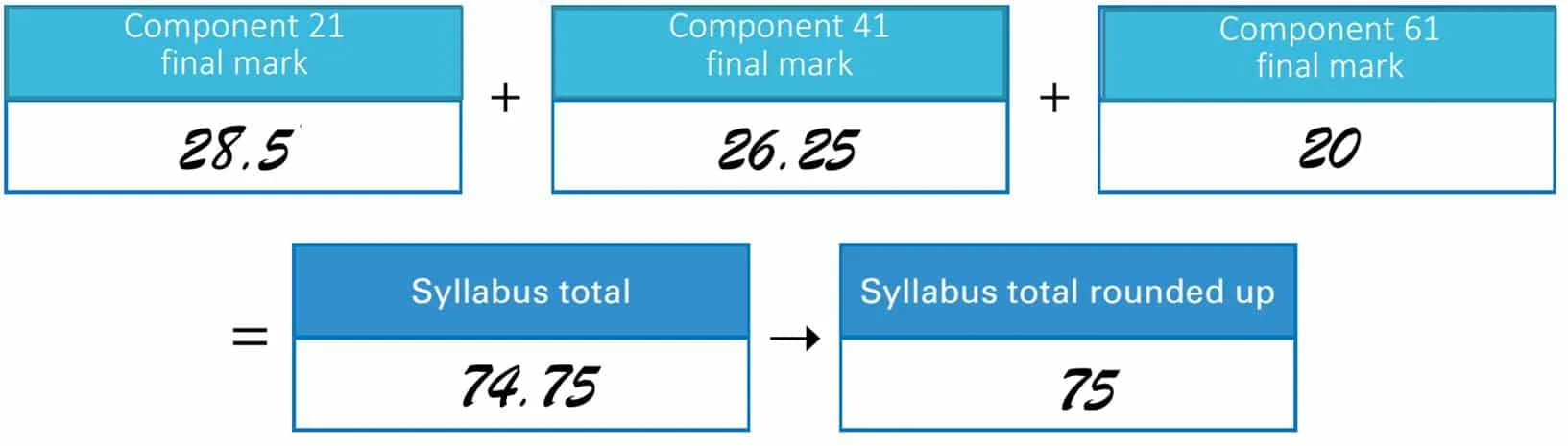
For example, the candidate’s component 41 adjusted mark (21) is multiplied by the component’s weighing factor which in this case is 1.25. This will lead to the candidate’s component 41 final mark of 21 x 1.25 = 26.25.

Consequently, when all the component’s final mark is computed, the candidate’s syllabus total can be calculated by adding it. For example, the candidate?s final marks for each component are 28.5, 26.25 and 20 for Components 21, 41 and 61 respectively. The sum of all of these component marks totals to 74.75. It is then rounded off to the nearest whole number that is 75.
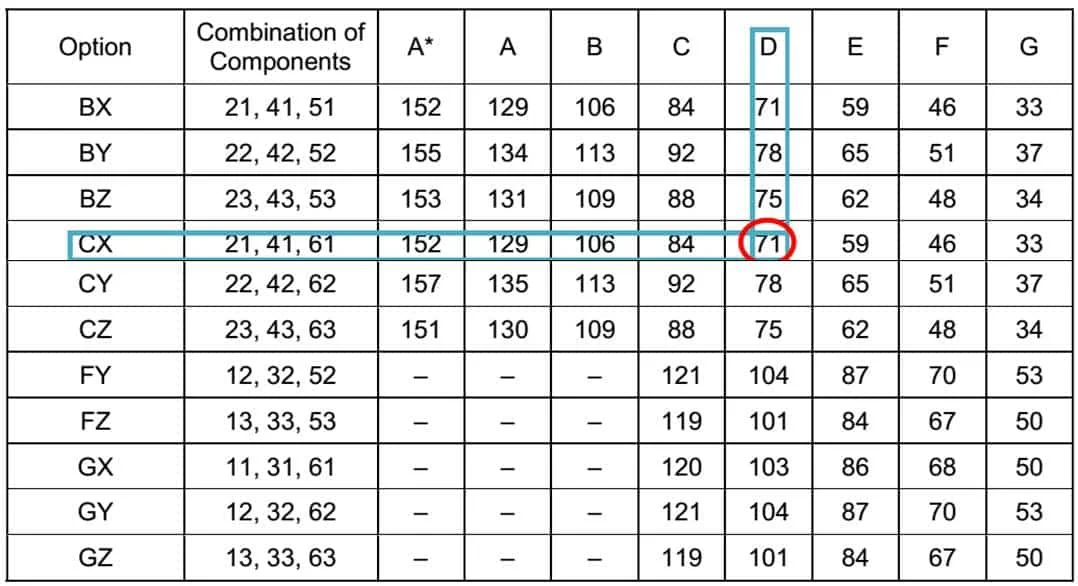
Compare the syllabus total to the overall grade threshold. Make sure that the option code is correct. As the grade thresholds for different options may not be the same.
For example, if the candidate took the combination of Components 21, 41, and 61, the syllabus grade should be compared to Option CX grade threshold. As such if the candidate’s syllabus total is 75, it falls under the Grade D threshold because Grade D threshold are for 71 marks and above. The Grade C threshold is for marks that are 84 and above.
* All info taken from CIE. The above video is made by CIE.


Somya Damania
India

Ahmad Kadiri
South Africa

Omayma Muhammad
Saudi Arabia
Understanding your Cambridge International exam results can often feel like decoding a complex language. While your final letter grade (A*,

If you are wondering what is A level, it is one of the most recognised pre-university pathways in the world,

Preparing for your IGCSE English as a Second Language (ESL) exam can feel daunting. You are not just learning grammar

Choosing the right educational pathway for your child is one of the most significant decisions a family can make. In
130 responses
Hello IGCSE Centre,
My friend have mistakenly used correction tape on all of her answer scripts in the exam. May I know how will that affects her results ?
Hello JCQ,
The answer papers may be scanned to allow online marking by examiners and correction fluid or tape can cause issues when scanning. The use of erasable pen during writing examinations often leaves smudges, making papers harder to read. Although there are no automatic deductions, it may cause you to lose marks because the examiner won?t be able to see your full answers.
Alternatively, please kindly write to the exam board, CIE, about this matter. Only the exam board, or the exam officer in your school is able to give this confirmation to you.
I am applying for 2019 feb-march exams ,so i want to know on which topic should i focus in chemistry,biology,physics ,business studies and maths .
And also in India which question paper does student write p22,42,62?
Please help me with my concern
Hello AVD,
We suggest that you refer to the latest syllabus on what is expected during exams here: https://www.skolatis.com/cambridge-igcse-subjects-syllabuses/ ). Then you can use the past exam papers (https://www.skolatis.com/cambridge-igcse-past-exam-papers/ ) to give you an idea of what the exam looks like.
Furthermore, there is a compulsory combination of papers needed for each subject. Please consult your teacher / exam centre properly, before you make any mistake.
Lastly, the number in the end of each paper is the variant number. The variant numbers are for different administrative zones. You can find your administrative zone here: https://www.skolatis.com/cambridge-igcse-exam-schedules/
what if I get a mark of 75 in my results saying it is a B on the results sheet but according to the grade boundaries 75 is an A*
Hello,
The statement of results shows your percentile not your mark. The numbers shown in a bracket is the percentage uniform mark (PUM). It corresponds to the grades available (A*, A, B, C etc.) and gives students additional information about their performance. They show students whether they are in the middle of a grade or near the top or bottom.
Greetings,
I am kindly requesting you to explain if grade threshold is used for every candidate globally.
can i get the list of students who have achieved A* IN 2017 from india
Hello,
We do not have list of those. But you may contact CIE (the exam board) directly for that.
When will the grade threshold and marking scheme of june2018 release ?
Hello Wamiq,
Grade threshold and marking scheme will only be published after the release of the result.