
Percentage Uniform Marks (PUM) Explained: A Comprehensive Guide
Understanding your Cambridge International exam results can often feel like decoding a complex language. While your final letter grade (A*,



Cambridge designed the ICE (International Certificate in Education) certificate as a group award for schools that want to offer a broad curriculum. Candidates enter and sit for a minimum of seven subjects selected from the five IGCSE curriculum areas:
Here are the Cambridge IGCSE subjects:
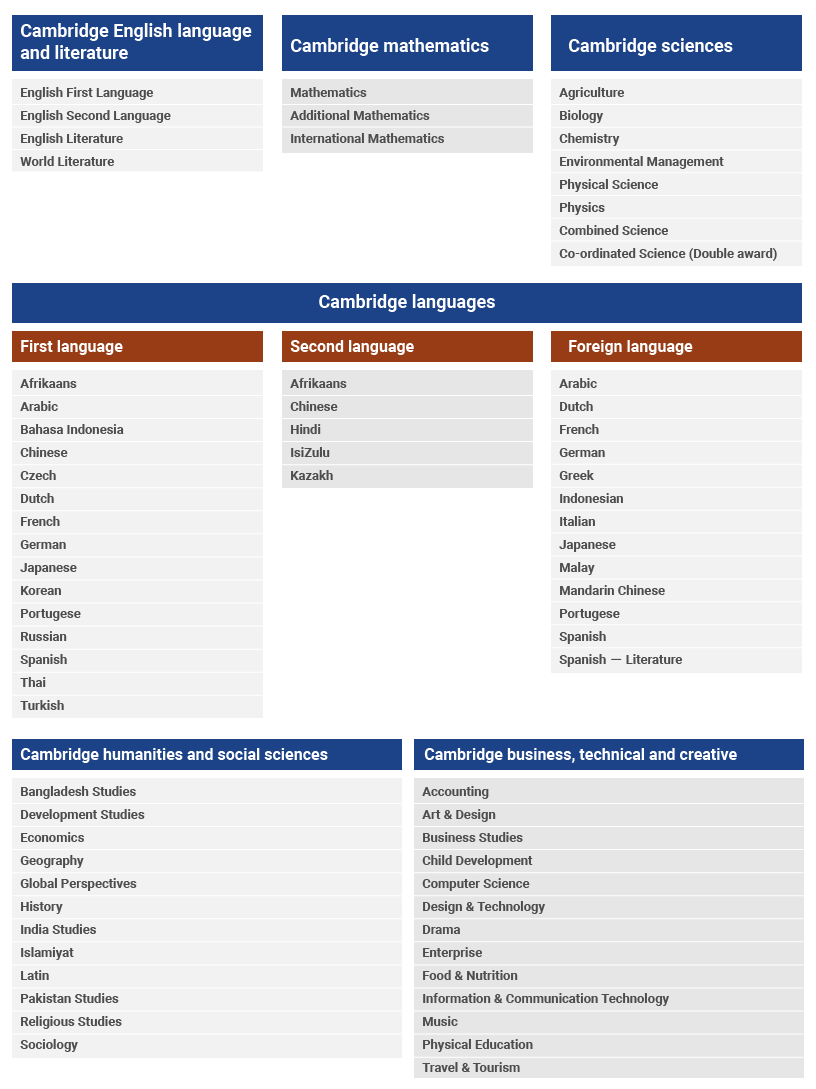
Candidates must take two different languages from Group I, and one subject from each of Groups II, III, IV and V. Candidates can choose the seventh subject from any of the five subject groups.
Below are the listing of the subjects groupings. Please note that not all subjects are available in both the June and November series.
Environmental Management can count as either a Group II or a Group III subject, and Co-ordinated Sciences (Double Award) counts as two subjects.
[one_third]
First Language
[/one_third]
[one_third]
Second Language
[/one_third]
[one_third_last]
Foreign Language
Additional Language
[/one_third_last]
Candidates who qualify for the Cambridge ICE award will be placed in one of three categories:
Another important benefit that Cambridge ICE offers is that candidates can demonstrate competence across a wide range of subjects and skills. Cambridge ICE carries greater currency in its own right in those countries where it is popular.
Section 4 of the Cambridge Guide to Making Entries provides full details of the subject groups and procedures for making entries for Cambridge ICE. Schools and exam centres must refer to this guide during exam registration.
Join 62,169 (and counting) IGCSE & AS/A Level subscribers who've taken our insanely valuable FREE email courses. Learn exam tips & score A* in your exam!
No. Candidates can qualify for Cambridge ICE over two series provided they take place during a period of 13 months, i.e. June to November, June to June, November to June, or November to November.
Yes, you can, but it is the result you achieved at the first sitting that will be counted towards your Cambridge ICE certificate. Cambridge will report the result you achieve at the second sitting on a separate subject certificate.
Cambridge allows certain subjects taken at GCE Ordinary Level to count towards ICE. However, candidates cannot substitute a subject if it is available as an IGCSE subject in the same series. Cambridge will not award an ICE certificate to any candidate who has taken fewer than six IGCSE subjects. Customer Services can confirm whether your particular O Level qualifies for ICE.
As long as you fulfil the entry requirements for Cambridge ICE (passes in seven subjects, covering the five IGCSE subject groups and including two different languages), Cambridge will calculate your ICE grade using your seven best results, regardless of subject or group.
Yes. A School must make a separate entry for the Cambridge ICE Award for each candidate who fulfils the Cambridge ICE entry criteria. To enter a candidate for the Cambridge ICE Award, a School must make an entry by means of the Cambridge ICE entry code in addition to the syllabus and option codes for the examinations the candidate takes. If you do not include Cambridge ICE in the candidate entry, Cambridge will issue only IGCSE certificates without the Cambridge ICE certificate.
Candidates can enter syllabuses that contribute to the Cambridge ICE group award in either a single examination series or two examination series, as long as both take place within a 13-month period. For example, candidates entering for the ICE award in the November 2015 could use previous results gained in the November 2014 or June 2015 series, but not both.
You must enter the group award entry code ICE along with the syllabus entry codes to make a separate entry for students who wish to enter for the Cambridge ICE Award. For two-series students, you must enter them for Cambridge ICE in their final examination series. You must also submit previous entry details for students who need results from earlier series to be included in the Cambridge ICE award.
If you do not include ICE in the student’s entry, Cambridge will issue only IGCSE certificates without the Cambridge ICE certificate.
You can find full details of the choice of subjects and entry criteria for the Cambridge ICE Award in the Cambridge Guide to Making Entries.
It is not possible to retrospectively apply for a Cambridge ICE Group Award, so care should be taken to ensure that the entry information provided for each student satisfies the Cambridge ICE Group Award entry criteria. To enter a student for the Cambridge ICE Group Award, a school must make an entry by means of the ICE entry code in addition to the syllabus and option codes for the examinations being taken by the student. The ICE entry code is ICE. Failure to include ICE in the student entry will result in only Cambridge IGCSE results and certificates being issued. The Statement of Entry issued to each candidate will confirm whether the ICE entry criteria has been satisfied.
Refer to the Cambridge Guide for Making Entries for the relevant examination session to learn how to make entries for the Cambridge ICE group award. You can download this guide from the Support Materials section of CIE Direct.
Schools do not need to submit Forecast Grades for Cambridge ICE as it is a group award. However, if you wish to remove the ‘Grades required’ warning on CIE Direct for ICE, you can enter the Forecast Grades as ‘X’.
To qualify for an ICE certificate, a student must obtain at least grade G(g) in each of seven subjects. These must include two subjects from Group I (Languages) and at least one subject from each of Groups II (Humanities ), III (Sciences), IV (Mathematics) and V (Creative, Technical and Vocational).
ICE certificates show the level achieved in the ICE group award:
Students who achieve ICE in one series will receive an ICE Statement of Results and two separate IGCSE and ICE Certificates.
Two series ICE students will receive a certificate for the individual subjects taken at the end of the first series and two separate IGCSE and ICE certificates at the end of the second series.
If a candidate qualifies for the Cambridge ICE Diploma, they must add the relevant entry code to their entries to be entered for the award, just like a normal entry code. You can find an example of this on the Final Entry Form.
The entry code for Cambridge ICE Diploma is simply ‘ICE’.
* All info taken from CIE.


Amal Elsayed
Kuwait

Understanding your Cambridge International exam results can often feel like decoding a complex language. While your final letter grade (A*,

If you are wondering what is A level, it is one of the most recognised pre-university pathways in the world,

Preparing for your IGCSE English as a Second Language (ESL) exam can feel daunting. You are not just learning grammar

Choosing the right educational pathway for your child is one of the most significant decisions a family can make. In
92 responses
Hi,I would like to ask if you have any idea of when the ICE Certificates will be dispatched as I can’t find any information about when it will be dispatched to the exam centres.
Thank you very much.
Hi Joshua,
Please find out all the key dates here: https://www.skolatis.com/exam-registration-dates/
The ICE certificates would be despatched on the same day as certificates despatch date.
hey, if i accidentally punch a hole on the margin of the paper, but IT IS NOT the barcode, barcode area is perfectly fine, will they penalize you and disqualified you from that particular paper?
Hello Aren,
We don’t think so there is any punishment for punching a hole on the paper. As long as your answers and all your information are visible, it should be fine.
I am taking 5 IGCSE subjects this year which are Business, Accounting, Economics, Engish Lit, and Physics and will give their exams in June in Lebanon. In November I will be giving English Language and Hindi in India. so it possible to get the ICE award and when do i register for it? In Lebanon or in India?
And how many IGCSE subjects do i need to take to register for A levels?
Hi Nazera,
If you did register for ICE during your exam registration and have fulfilled the requirements of the subjects, then you are qualified for the Cambridge ICE award. You will be placed in one of the three categories:
Distinction ? Grade A or better in five subjects and grade C or better in two subjects.
Merit ? Grade C or better in five subjects and grade F or better in two subjects.
Pass ? Grade G or better in seven subjects.
You can read more here: https://www.skolatis.com/what-is-igcse/
If i take more than 1 subject from group sciences, can i still get the ICE award?
I’m taking 8 subjects which are:
Chemistry
Biology
Physics
Geography
Maths
English (first language)
French foreign language
ICT
Hi Sania,
If you did register for ICE during your exam registration and have fulfilled the requirements of the subjects, then you are qualified for the Cambridge ICE award. You will be placed in one of the three categories:
Distinction ? Grade A or better in five subjects and grade C or better in two subjects.
Merit ? Grade C or better in five subjects and grade F or better in two subjects.
Pass ? Grade G or better in seven subjects.
You can read more here: https://www.skolatis.com/what-is-igcse/
Hello IGSCE center,
I would like to ask you about ICE, and before you say, I have read the article thoroughly, but what is the actual ‘usefulness’ of this award
I currently study 6 subjects and obviously can’t apply for ICE
however, I can take two more subjects (I would consider Islamiat and Arabic Fl) to satisfy ICE, the only thing is, I have only about 8 months to the next may June, so is this enough time to go through syllabi of both subjects
Last question, what is the comparative usefulness of ICE when compared to an outstanding Cambridge learner award.
? Footnote 1: really appreciate the website but the splash screen that comes in is annoying, you could make a side advert, or allow make splash screen to be manually closed (the auto-close makes scrolling annoyance)
? Footnote 2: I wonder why it takes too long for moderation, last time it took about 4 days to moderate and reply, hopefully, i am not annoying you
Regards,
IGCSE center fan ?
Hi Diram,
One important benefit that Cambridge ICE offers is that candidates can demonstrate competence across a wide range of subjects and skills. Cambridge ICE carries greater currency in its own right in those countries where it is popular. Other than that, it is considered as extra and could be used in the future if it is needed.
To be eligible for the Cambridge ICE, your school must make a separate entry for the Cambridge ICE Award, provided you fulfilled the Cambridge ICE entry criteria.
On the other hand, the Outstanding Cambridge Learner Awards were introduced to celebrate the achievements of learners who outperform their peers. It has a few categories – ?Top of the World?, ?Top in Country?, ?High Achievement?, etc. You can read more here: https://www.cie.org.uk/images/208585-outstanding-cambridge-learner-awards-faqs.pdf
And all these awards may be useful when you apply for a University or College.
Hey, I am afraid that I got 4 B’s and 2 C’s .These were the subjects I have taken Maths, Biology, English,Computer science,physics and chemistry.So in which level do I get to place myself.
Hi Marwa,
If you did not register for ICE, there is no ?level? to place yourself in IGCSE. The grades are an indication on the subject’s achievements.