
Percentage Uniform Marks (PUM) Explained: A Comprehensive Guide
Understanding your Cambridge International exam results can often feel like decoding a complex language. While your final letter grade (A*,



Announcement:
Cambridge International Education no longer be an Ofqual-recognised awarding organisation from December 20, 2024.
Cambridge International AS & A Levels are world-class qualifications taken by over 175,000 students in 160 countries every year. Recognised by the world’s best universities, including the Ivy League and Russell Group, they represent the “gold standard” of international pre-university education.
In this guide, we break down everything from the modular structure and grading thresholds to the specific strategies required to secure an A*.
The Cambridge International A Level (Advanced Level) is a two-year course of study, while the AS Level (Advanced Subsidiary Level) typically represents the first year of that journey.
The AS Level is a qualification in its own right. Many students take 4 subjects at the AS Level to maintain breadth before narrowing down to 3 subjects for the full A Level in their final year. It is worth exactly 50% of the total marks of a full A Level.
The A2 refers to the second year of the A Level syllabus. It is generally more intellectually demanding, requiring students to synthesize information and apply theories to complex, unseen scenarios. You cannot take the A2 alone; it must be combined with your AS marks to form a full A Level grade.
One of the most significant advantages of the Cambridge system is the flexibility in how you are assessed. Unlike some national curriculums, Cambridge allows you to choose a path that suits your stress tolerance and academic strengths.
You take the AS Level in one exam series (e.g., May/June of Year 12) and the A2 in a later series (e.g., May/June of Year 13).
You take all papers (both AS and A2 components) in the same exam session at the end of the course.
You take the AS Level and stop there. This is common for subjects a student is interested in but doesn’t intend to pursue at the university level.
Many students are unaware that they can earn a prestigious Group Award alongside their individual A Level certificates. This is known as the Cambridge AICE Diploma (Advanced International Certificate of Education).
The AICE Diploma is highly valued by universities (especially in the US, where it can lead to significant college credit) because it proves a student has a broad, balanced education across multiple disciplines.
To earn the diploma, you must achieve a minimum of 7 credits (where an AS Level = 1 credit and an A Level = 2 credits) across four mandatory groups:
A common mistake students make is assuming the Diploma is awarded automatically. It is not.
Cambridge grading is rigorous. It is important to note that the grading scale for AS Level differs slightly from the full A Level.
| Qualification | Possible Grades |
| Full A Level | A*, A, B, C, D, E |
| AS Level | a, b, c, d, e |
*Why is there no A at AS Level?**
The A* grade was introduced to help top universities differentiate between the very best candidates. It is awarded based on a student achieving a high cumulative score across both AS and A2, with particularly strong performance in the A2 components. Therefore, it is impossible to earn an A* halfway through the course.
With over 55 subjects available, students often struggle to choose the right combination. Universities generally prefer “facilitating subjects” that demonstrate high-level analytical skills.
Below are the Subject Groups for the 55 subjects:
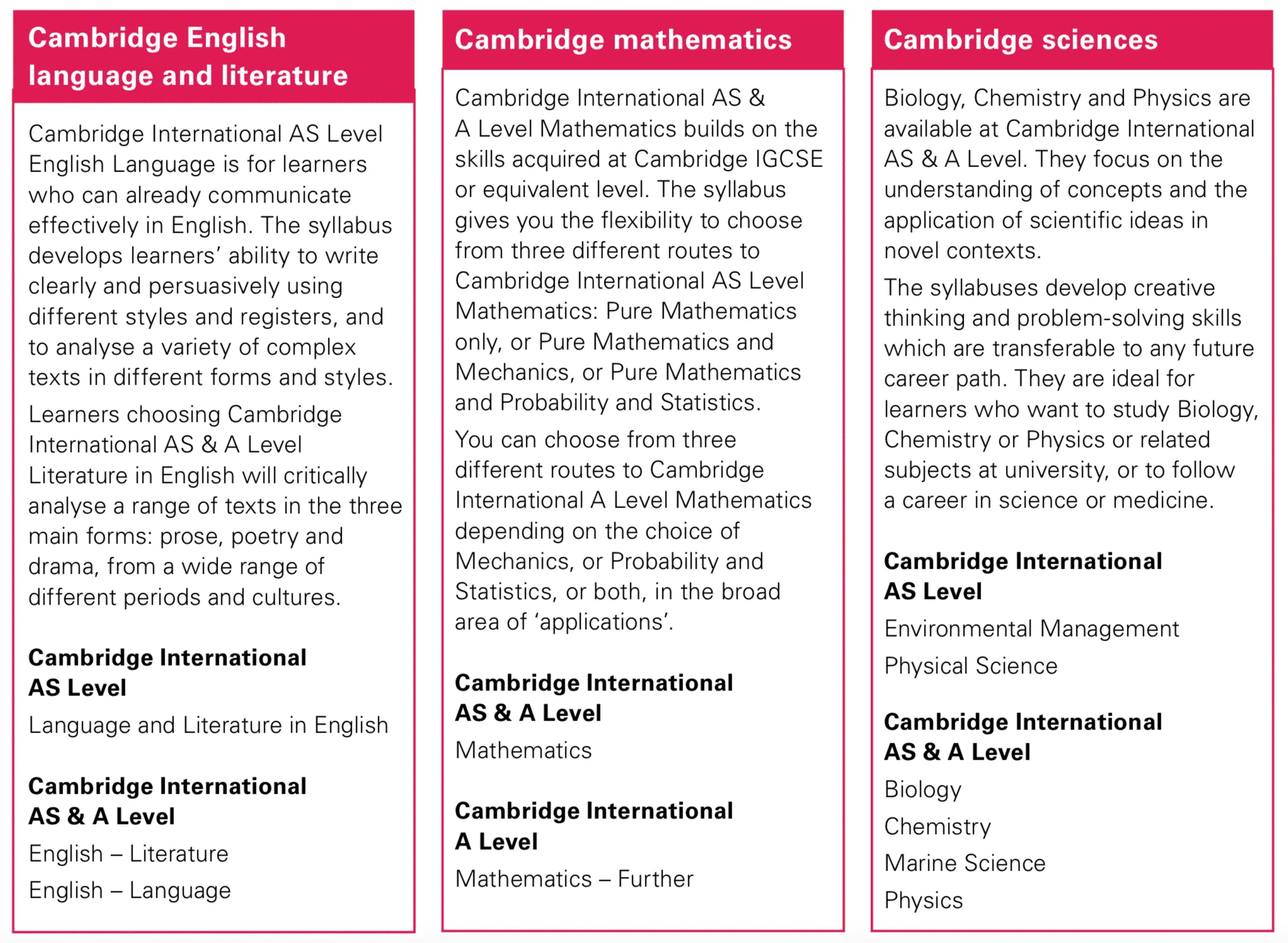
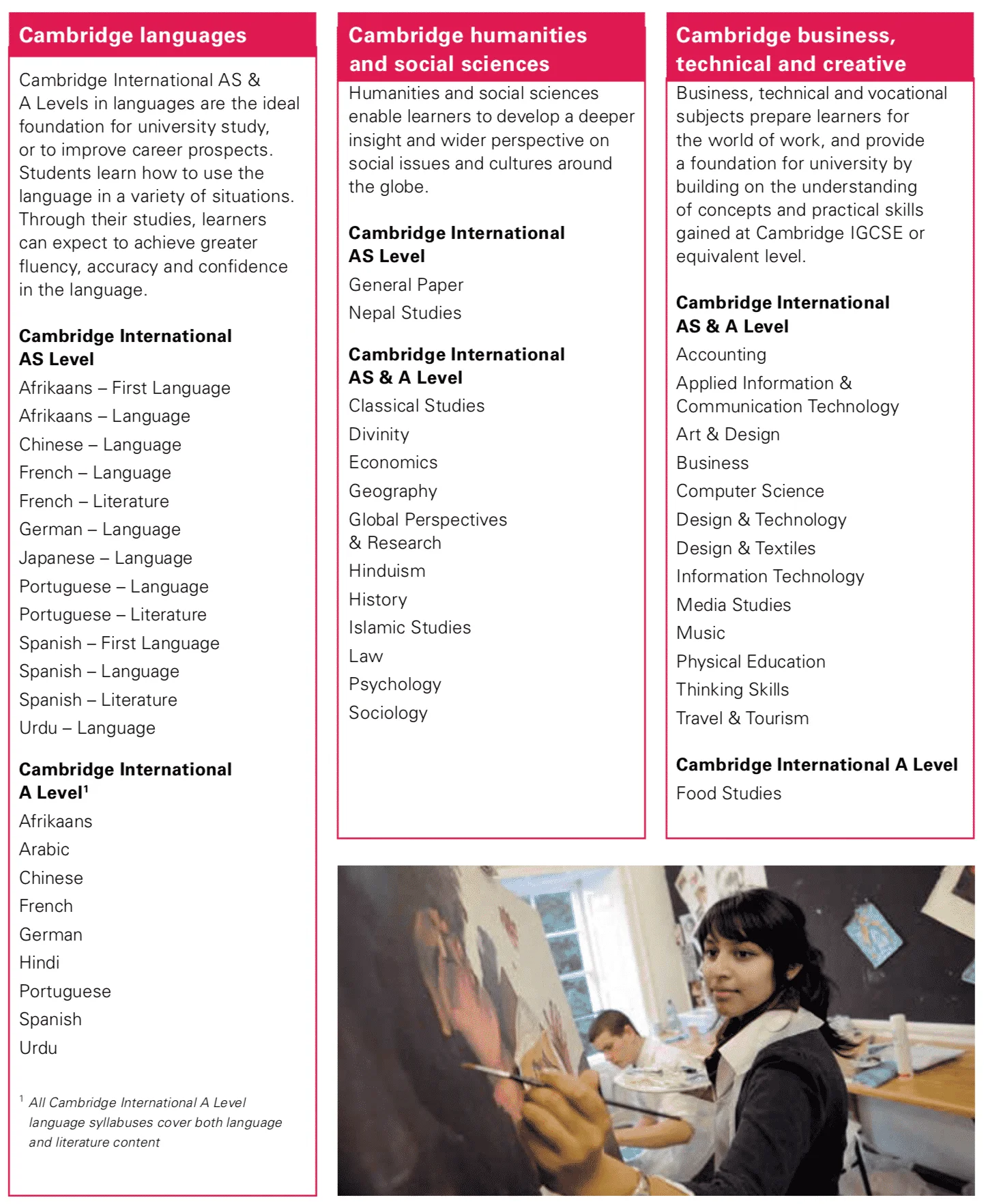
Choosing between Cambridge and other boards like Pearson Edexcel is a significant decision. Both are respected globally, but they offer very different academic experiences.
Assessment Style (Linear vs. Modular): The biggest difference is that Edexcel allows for a modular approach. This means you can take individual units (exams) at different times and retake a single unit if you underperform. Cambridge is primarily linear or staged, meaning you must sit all components of a level (AS or A2) together.
Syllabus Breadth: Edexcel’s modular structure often allows for a broader range of topics to be covered across its units. For instance, students heading into Math-heavy university degrees (like Engineering or Physics) often find that Edexcel’s specific modules provide a broader foundation in areas like Linear Algebra or Mechanics.
Depth and Rigor: Cambridge syllabi are designed for “Deep Learning.” While the volume of topics may be more focused than some modular boards, the questions often require a higher level of conceptual synthesis—joining different parts of the syllabus together in a single complex question.
The Verdict: If you prefer a “building block” approach where you test and “bank” your results unit-by-unit, Edexcel may be your preference. If you prefer a structured, two-stage journey (AS then A2) with a focus on deep conceptual mastery, Cambridge is the global leader.
Achieving top grades in Cambridge exams requires a shift from “memorization” to “application.” Examiners want to see that you can use what you know in unfamiliar contexts.
* Ready to ace your exams? Explore our Course Catalog and start your journey to an A* today.
Can I retake my exams to improve my grade?
Yes. You can retake any syllabus to improve your grade. However, because Cambridge is a linear/staged board (not modular like Edexcel), you must retake the entire AS Level or the entire A2 component. You cannot retake a single “Paper” (e.g., just Paper 1) in isolation.
How does the “13-Month Rule” work for carrying forward marks?
If you take your AS Level in June 2024, you can carry those marks forward to complete your A Level in November 2024 or June 2025. After 13 months, the AS marks expire, and you would need to retake the AS components again to get a full A Level.
What is the “Best of Both” rule?
If you retake an AS Level within 13 months of your first attempt, Cambridge will automatically use the higher of your two AS results when calculating your final A Level grade. This “safety net” allows students to aim high without fear of ruining their previous progress.
Is the A* available for AS Level?
No. The highest grade for an AS Level is an ‘a’. The A* is only awarded at the end of the full A Level for students who demonstrate exceptional performance across both years (specifically reaching a high threshold in the A2 components).
How many A Levels do I need for university?
* Read more about AS & A Level frequently asked questions.
The journey to an A* is a marathon, not a sprint. Whether you are struggling with organic chemistry or trying to master macroeconomics, Skolatis is here to help. Simply leave a comment in the comment box below, a friendly Team Skolatis will attend to your query promptly.
[Enrol in a Skolatis Course Today] | [Browse Our Model Answer Library]
Our valuable A* resources had produced thousands of A* scorers around the world. Check them out below.
Our internationally loved exam model answers had helped thousands of students in scoring A/A*. Schools and teachers worldwide have used these resources to aid in their teachings. Learn what an A* answer like, copy the style and score A* in your exam.
Our word-renowned IGCSE and AS/A Level courses had produced more than 1100 A/A* scorers worldwide. They are suitable for schooled or home-schooled candidates, and as full course or revision course.
We have the most complete past exam papers library on earth (no kidding!). Choose your exam board and download everything with one click.
Get the latest exam syllabus and plan your study accordingly.
Find out the exam registration and results released key dates for IGCSE and AS/A Level.
Check your administrative zone, the exam dates and time. For both IGCSE and AS/A Level.
Find and locate the nearest exam centre for your location.
Note: CIE (Cambridge International Examination board) has its name changed to CAIE (Cambridge Assessment International Education) since October 2017.
In October 2023, CAIE updated its name, logo, look, and messaging. Cambridge International Education is the new name of the awarding body of Cambridge University Press & Assessment. This name will be used on materials related to administering exams and awarding qualifications.
Note: All relevant info taken from CIE.


Arun Joseph
Botswana

Understanding your Cambridge International exam results can often feel like decoding a complex language. While your final letter grade (A*,

If you are wondering what is A level, it is one of the most recognised pre-university pathways in the world,

Preparing for your IGCSE English as a Second Language (ESL) exam can feel daunting. You are not just learning grammar

Choosing the right educational pathway for your child is one of the most significant decisions a family can make. In
86 responses
Hello,
I am from India and I am going to be writing my A level exam during the Feb/March series and I was wondering if we can use gel pen, or are we only allowed to used ball point pens.
Thank you!
Hi there,
Gel pens are discouraged because they are often illegible when scanned. We suggest that you use a black ink pen.
Good luck with your exams!
Hello Team,
I am grateful for the service you offer on this website and I am even recommending it to my friends ! I live in India and am currently pursuing my AS-Levels.I just wanted to say please suggest a website where I can download teachers’ resources pdf files for free.I need the following subjects…
1. Physics (9702)
2.Chemistry (9701)
3. Business (9609)
Once again I thank you for the favor you have done to me.I look forward to your reply.
Regards,
Ranjit Sharma
Hi Ranjit,
Thank you for your kind words.
We do not host teachers’ resources on our site. If you are a schooled candidate, please ask your school for helpful resources. They can provide with you that.
You can also sign up for our AS/A Level newsletter for exam tips and techniques. Kindly tick AS/A Level to receive our emails when you sign up here: https://www.skolatis.com/newsletter/.
Thank you so much for being so understanding. Good luck with your exams!
Hello i finished my IGCSEs and got good marks such as A* in accounts and A in economics and I am current doing AS levels in those subjects plus geography and English language, however i got a C in maths and didn’t take it up for AS level, i would like to study economics or accounts but seemingly most universities want AS level mathematics so am i wasting my time and won’t get accepted no matter how high my grades will be in economics and accounts?
Hello Sakhiwo,
Thank you for writing in.
Mathematics is one of the core subjects when applying to colleges and universities. We would suggest that you take Maths at A Level so you can meet their subject entry requirements.
Furthermore, it is best that you inquire directly to your chosen university as they are the only one who can confirm this part for you.
Thank you.
Hey I am from India , I’ve heard from my teachers that in India you can do commerce with AS and A levels But you can’t do any science degrees with these . To do that do I really have to opt for CBSE , please answer as soon as possible .
If I wish to continue , I have to go abroad to do my sciences , is it true?
Hello Manish,
AS and A Level offer both science and commerce subjects. Please kindly read the article above and find out the subject groups.
If your school does not offer AS/A Level science subjects, you may register as a private candidate with your local British Council. We strongly suggest that you first find out what are the AS/A Level subjects available in your local British Council.
hey can I get a discount of 30 to 40 % in online single cources because i cannot pay 75 pounds for a subject even .
Hello Yash,
Thank you for your message.
Please kindly subscribe to our newsletter here: https://www.skolatis.com/newsletter/ to receive alerts for our promos, discounts and scholarship programmes.
thank you for response , i have already subscribed
but i have not got any message .
Hello Yash,
Please kindly wait for our free email series. Furthermore, we are having another free lessons soon so please kindly watch out for that.