Percentage Uniform Marks (PUM) Explained: A Comprehensive Guide
Understanding your Cambridge International exam results can often feel like decoding a complex language. While your final letter grade (A*,


IGCSE stands for “International General Certificate of Secondary Education.” It is an internationally recognised qualification for secondary school students, typically taken by students aged 14 to 16. IGCSE provides a broad and balanced education while also letting students to develop essential skills and knowledge.
IGCSE is equivalent to O Level, UK GCSE, fifth form or year 11 in respective countries and schools. It is the pre-requisite qualification before one proceeds to Advanced Level (A Level) or sixth form (year 12 & 13) or pre-university studies.
There are two main exam boards that offer IGCSE to international learners. Namely, Edexcel and CIE (Cambridge International Education).
Announcement:
Cambridge International Education no longer be an Ofqual-recognised awarding organisation from December 20, 2024.
In order to know which one is best for you, please follow the detailed analysis outlined here:
Determining whether Edexcel IGCSE or Cambridge IGCSE is “better” depends on several factors, including your goals, future studies, and subjects availability. Edexcel IGCSE and Cambridge IGCSE are international qualifications with similarities in grading and subject offerings.
Edexcel IGCSE has a much straight forward approach, with only one type of paper combination for all learners. Thus, all learners have equal chances to score grade A* (or grade 9 with the new grading scale system).
Cambridge IGCSE has more (and rather complicated) paper combinations. Exam entries are based on teachers’ grade prediction towards the learners. Therefore, teachers’ predictions are often contradicting with what learners wish to achieve at final exams. Consequently, resulting in lower paper entries that prevent the learners to achieve higher grade in the exams. Learners have complaint not able to adjust exam entries in time, and are facing high level of stress.
Here is one of the many SOS messages:
“I actually I want to study medicine. So u know that universities needed grades like A* TO B. but I knew the core grade’s maximum, so I shocked to hear that. If you imagine that I got the grade C but it is not related to the university requirements so it is not possible to enter to my dream careeer. I also paid the fees for the IGCSE exam. Our school, also didn’t explained that clearer. Ok, So is there any ways to change the curriculum from core to extended. Any way or method (suggestion from you) “
As a homeschooler, you have much more control in choosing the subjects and paper combination. This however, has to be done based on your future study and career plans. If you need help in deciding on your subject group, simply drop us a message at the comment box below. We shall reply you within 24 hours.
Besides the freedom to choose the subjects and paper combination, private candidate is also free to register for exam whenever they are ready.
Join 62,169 (and counting) IGCSE & AS/A Level subscribers who've taken our insanely valuable FREE email courses. Learn exam tips & score A* in your exam!
Edexcel board currently offers 37 subjects for the International GCSE examinations. Edexcel’s iGCSE curricula are well established, and consistent throughout the learners’ learning journey. The curricula do not constantly change and thus learners can learn with peace of mind.
Learners may choose the subject combination based on their future studies in higher education.
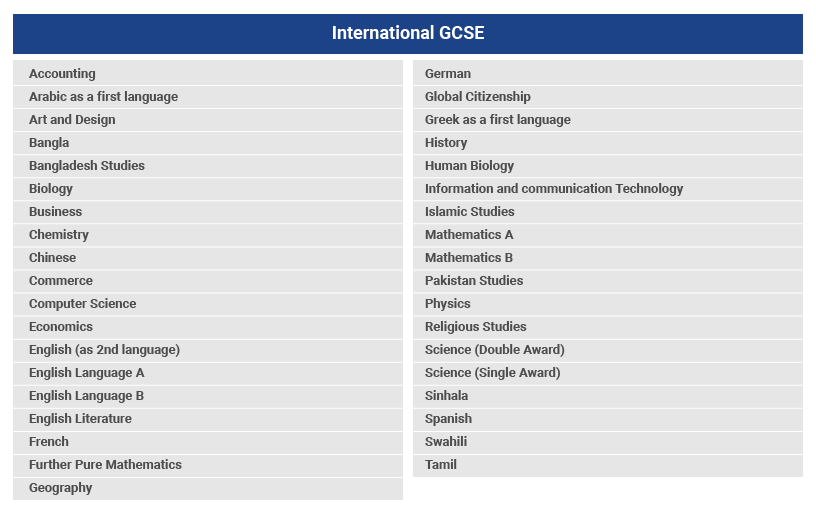
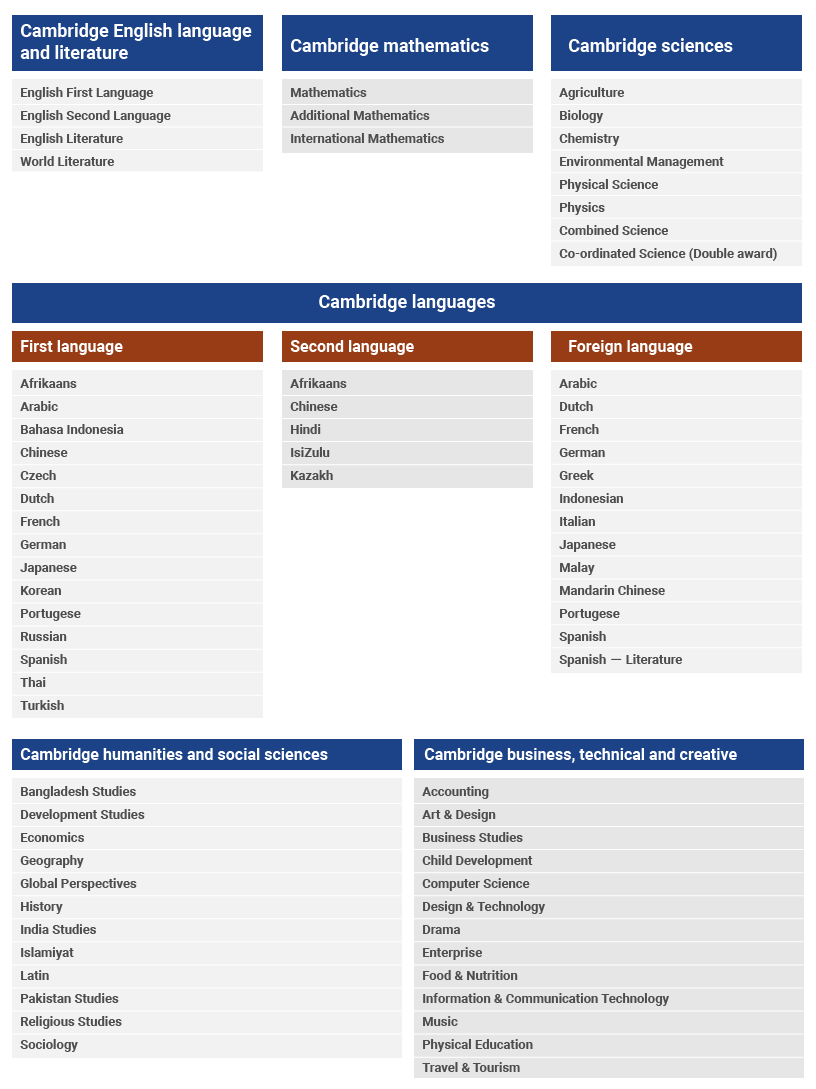
Cambridge IGCSE offers more than 70 subjects. Students are required to take a minimum of 5 or maximum of 14 subjects. The core subjects are English, Mathematics and Sciences. Students can also choose other subjects ranging from Social Sciences (commonly Accounting, Business Studies, Economics, Sociology) to Arts & Technology (commonly Computer Studies, Information & Communication Technology (ICT), Art & Design).
Student is awarded with one IGCSE certificate on each subject. For example, you will obtain 5 IGCSE certificates, if you take 5 subjects. Each school decides upon the number of compulsory subjects differently. However, a private candidate may decides based on individual preference.
Edexcel iGCSE curricula are well-established, stable and based on current international audience requirements. Besides that, they have more extensive and wide range of topics that are prerequisite knowledge prior to International A Level studies.
Example topics and chapters that are available in Edexcel iGCSE, but not in Cambridge IGCSE:
Cambridge IGCSE curricula are regularly updated and extended on a yearly or every 2-year basis. Therefore, this has become a great challenge for learners, parents and teachers to catch up with the constant changes.
Example incident:
A teacher in a private school in the UK was not aware of the change of syllabus for English First Language. We managed to assist her with the new exam syllabus just 2 months prior to the exams.
In view of the constant change of Cambridge IGCSE syllabus, here at Skolatis, we have developed a system to keep updating our course material so that candidates are learning the right exam syllabus. Parents can have peace of mind that their children are learning the right syllabus.
Cambridge IGCSE Curriculum is divided into 6 main subject groups. Each group contains several subjects which learners can choose from, in order to fulfil the minimum required subjects.
IGCSE (International General Certificate of Secondary Education) and GCSE (General Certificate of Secondary Education) are both qualifications that students in the United Kingdom and many other countries can earn, typically during their secondary education.
The main difference between IGCSE and GCSE lies in their geographic scope, curriculum, assessment methods, recognition, and flexibility. IGCSE is more internationally focused and flexible, while GCSE is primarily used in the UK and follows the UK national curriculum. Therefore, students and parents should consider these differences when choosing the most suitable qualification for their educational goals and circumstances.
GCSEs are primarily taken in the United Kingdom, including England, Wales, and Northern Ireland. However, in Scotland, a different system of qualifications is used.
IGCSEs are designed for international students and are offered by Edexcel and CIE. They are not limited to the UK and are used in many countries as an international qualification.
GCSEs follow the national curriculum of the United Kingdom. The relevant examination boards (for example AQA, OCR, etc.) in each of the UK nations determine the content and assessment methods.
IGCSEs do not necessarily follow the UK national curriculum. They often have a more global perspective and can be more flexible in terms of the subjects and content offered.
GCSEs in the UK are assessed through a combination of coursework (controlled assessments) and final exams. The grading system for GCSEs uses letter grades (A*, A, B, C, etc.).
IGCSEs typically rely more heavily on final exams, with limited or no coursework. The grading system for IGCSEs may use letter grades or a numerical scale.
GCSEs are widely recognised within the United Kingdom and are the standard qualification for students in the UK education system.
IGCSEs are recognized globally and may be more suitable for students who plan to study abroad or want to have their qualifications recognized in multiple countries.
GCSEs offer less flexibility in terms of subject choices and the content of the qualifications. Students typically follow a prescribed set of subjects.
IGCSEs often offer more flexibility in subject choices, allowing students to tailor their education to their interests and needs.
Universities and employers worldwide widely recognise and accept Edexcel IGCSE and Cambridge IGCSE qualifications.
Here are some examples international learners’ admissions into top universities globally.
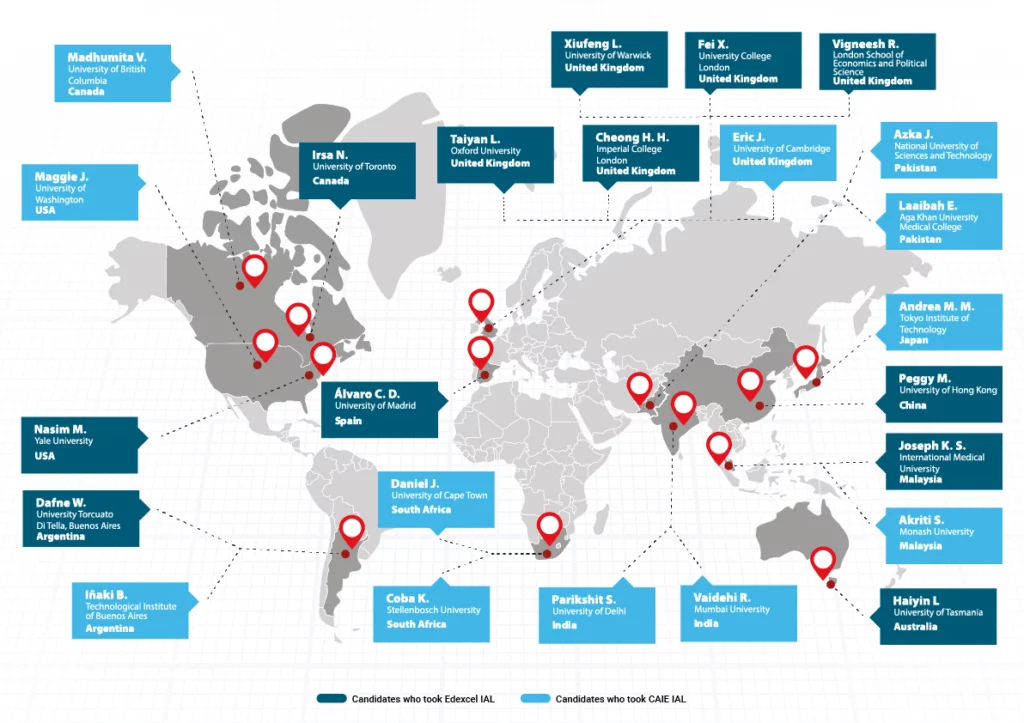
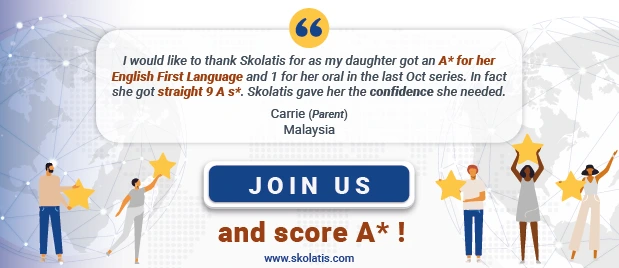
Edexcel IGCSEs typically include written examinations, coursework, and practical assessments. The weightage of these components may vary depending on the subject.
Cambridge IGCSEs primarily rely on written examinations, with limited coursework and practical components. Assessment methods can vary by subject.
Edexcel IGCSE exams typically occur in January and June, standardised globally. Starting from November 2023, Edexcel has introduced the November series, replacing the January series. January 2023 was the last January series for Edexcel IGCSE. Therefore, from year 2024 onwards, Edexcel IGCSE is taking place in May/June and October/November.
Please refer to Edexcel IGCSE exam timetable and exam registration key dates for more information.
Cambridge IGCSE exams usually take place in May/June and October/November. With exceptional cases of March series for India, Romania and some schools in the Middle East.
Please refer to Cambridge IGCSE exam timetable and exam registration key dates for more information.
Note:
Although IGCSE and O Level are equivalent qualifications grade for grade, they are two different qualifications. IGCSE syllabus meets international standards while O Levels syllabus meets specific local needs in each country. Other notable differences are the grading scale, assessment techniques, and coursework options.
| IGCSE | O Level | |
| Grading | Grades are awarded from A* (highest grade) to G (lowest) | Grades are awarded from A* to E |
| Assessment techniques | Tests oral and practical skills | Focuses on writing and reading skills in language subjects Restricted practical test options in sciences |
| Coursework options | Available in many syllabuses | Fewer coursework options |
* If you need help in choosing between IGCSE and O Level, just leave us a question at the comment box below. We are more than happy to guide you.
Our internationally loved exam model answers had helped thousands of students in scoring A/A*. Schools and teachers worldwide have used these resources to aid in their teachings. Learn what an A* answer like, copy the style and score A* in your exam.
Our word-renowned IGCSE and AS/A Level courses had produced more than 1100 A/A* scorers worldwide. They are suitable for schooled or home-schooled candidates, and as full course or revision course.
We have the most complete past exam papers library on earth (no kidding!). Choose your exam board and download everything with one click.
Get the latest exam syllabus and plan your study accordingly.
Find out the exam registration and results released key dates for IGCSE and AS/A Level.
Check your administrative zone, the exam dates and time. For both IGCSE and AS/A Level.
Find and locate the nearest exam centre for your location.
Please kindly read the IGCSE FAQs here.
Note: CIE (Cambridge International Examination board) has its name changed to CAIE (Cambridge Assessment International Education) since October 2017.
In October 2023, CAIE updated its name, logo, look, and messaging. Cambridge International Education is the new name of the awarding body of Cambridge University Press & Assessment. This name will be used on materials related to administering exams and awarding qualifications.


Amal Elsayed
Kuwait

Understanding your Cambridge International exam results can often feel like decoding a complex language. While your final letter grade (A*,
If you are wondering what is A level, it is one of the most recognised pre-university pathways in the world,
Preparing for your IGCSE English as a Second Language (ESL) exam can feel daunting. You are not just learning grammar
Choosing the right educational pathway for your child is one of the most significant decisions a family can make. In
2,343 responses
Hi,
My son Vedaang is studying in Grade 1 and his age was 5 yrs and 8 months as on 30 just July 2019 (DOB 19th Nov 2013).
In Grade 10 he will be 14yrs and 8 months old, so wanted to check whether he would be eligible for appearing exam in Grade 10?
What is the minimum age criteria for appearing for Grade 10
Thanks
Kailash
Hi Kailash,
The minimum age to sit in for IGCSE exams is 14 years old. As such, when your your son is in Grade 10 and ready to sit in for his exams, he is eligible to register for his IGCSE exams.
Dear IGCSE Support team,
I have 2 sons aged 9 and 10 years respectively.
We are currently living in South Africa but undecided about possibly moving to India to a school which teaches the Cambridge syllabus. If we do relocate, we will proceed through the school’s subject choices, but if we do not, then we will have to prepare the boys at home privately back in South Africa for eventually sitting for IGCSE exams.
My questions in this connections:
1. Please suggest on a syllabus to use most suitable to leading up to IGCSE. They are currently using the CAPSE syllabus (the South African National syllabous) for Maths, English and Science only. We study Maths and English , and we download local papers for them to write yearly exams at home. We are prepared to abandon the current program to find a more suitable syllabus which will lead up to IGCSE. Kindly advise us with the most appropriate route to take where study material and exam papers can be easily available on-line which will specifically lead up to IGCSE for their later years, catering to the most relevant core subjects of IGCSE.
2. Since the boys are still relatively young, it is difficult to decide privately what subjects to select for their studies, since their aptitudes are not yet absolutely clear to us. How should we go about making a selection of subject choices? I understand Maths and English are compulsory, but sciences may be from various sciences. Both boys are strongly inclined towards music, having acquired genes from me their father so that they are highly inclined to pitch and rhythm. They study piano and vocals informally with me, but we have found that music may not be a lucritive career, as it does not belong to a major “needs” industry but a secondary entertainment luxury service.
With the above details in mind, is there a syllabus program that leads them up to a point in their lives when they will be ready for studying for the core IGCSE exams, in a most general way, so that they can each then decide the route they wish to take for themselves when they are old enough?
Thank you kindly for considering my questions.
Kind regards,
Yogan
Hello Yogan,
Thank you for writing in.
Please find our suggestions below:
1. You may find all the relevant and IGCSE exam resources on our site.
For IGCSE syllabi, please download here: https://www.skolatis.com/cambridge-igcse-subjects-syllabuses/
For IGCSE past exam papers, please download here: https://www.skolatis.com/cambridge-igcse-past-exam-papers/
Here are our worldwide renown A* courses which you may consider enrolling: https://www.skolatis.com/cambridge-igcse-revision-courses/
To know and understand what is an A* answer like, please get the model answers here: https://www.skolatis.com/igcse-exam-resources/
By following the homeschooling route, this article would help in your planning: https://www.skolatis.com/what-is-homeschooling/
2. Choosing the exam subjects might be a little early at this age. We would suggest to go for the compulsory subjects, as mentioned in the article above. Science and art subjects are taught in school for primary level. You may follow the school’s primary level teaching materials. In this way, your boys have ample of time to decide at a later stage. IGCSE does offer Music subjects if your sons are going that route.
We hope these help. Please feel free to drop us a line if you need further assistance.
Dear IGCSE team,
Thanks for your kind advice and for the clear and intuitive layout of your content on the site, as well as your prompt and personalized replies to queries.
From what I have understood from my reading on the site, the entire IGCSE course is necessarily a maximum of 2 years to complete, approximately as the equivalent of grades 10 and 11. If I have understood this correctly, then:
1. Are there any formal processes put in place by the IGCSE board to ensure that students cannot sit for IGCSE studies for anything much more than 2 years? I’m just considering the possibility of starting out with actual IGCSE content at an earlier age (10 and 11 years old), and bridging any knowledge gaps as we go along, until they are actually ready, even if this takes a few years to write the exams. What is the formal requirement on this, and what is your practical suggestions beyond the formal requirement? Please can you write on both. Thanks.
2. Does a home schooling parent have to formerly enroll a child into the IGCSE program as a whole or per subject to get started with the studies, in order to eventually be permitted to sit for the IGCSE exam for a particular subject, or can they simply download the course material for a subject and take as many months/years as they need to, working through past year papers Etc, until the home-schooling parent feels the child is ready to write the exam for that subject?
3. Is there a minimum number of IGCSE subjects that a student can write in a single year?
4. In the case of a second language (we wish to move to India so would like the children to start learning Hindi from scratch), does the IGCSE course assume any prior experience with that language, or does the syllabus teach the basics of the language from scratch: elementary diction, pronunciation, grammer, Etc?
Thanks kindly.
Yogan
Hello Yogan,
Thank you for your kind words. Here are our suggestions:
1. The whole IGCSE syllabus takes approximately 1-2 years to finish but there is no hard rule that candidates must study IGCSE for a two year period. The 2 year period is usually for schooled students, following schools calendar plus holidays etc. As a private candidate, you may judge your readiness to sit for the exams independently. The only formal requirement is candidates must be at least aged 14 to sit for the exams. However, we have also experienced some countries do accept private candidates registration below age 14. You have to check with your local British Council for this. Practically, starting IGCSE content at such a young age might put strain and stress on the kids. This is due to missing a big gap of required basic knowledge prior to the IGCSE content. We would suggest you to give a Primary 6 (Year 6) test and a Year 9 test to both your sons to assess their current knowledge level. You can acquire both Year 6 and Year 9 tests reference books from your local bookstores or from Amazon UK site. Only after this, you can make the right decision.
2. As a homeschooling parent, you do not need to formally enrol your children in a school in order to start the IGCSE programme. You only have to register them when they are going to sit for their IGCSE exams. Exam registrations can be done either via your local British Council or any Cambridge schools which accept private candidates (https://www.cambridgeinternational.org/i-want-to/find-a-cambridge-school/). You are free to enrol your sons to IGCSE online courses, download past exam papers (https://www.skolatis.com/cambridge-igcse-past-exam-papers/), getting exam resources such as model answers (https://www.skolatis.com/igcse-exam-resources/), or have your practice papers marked by examiners/subject matter experts (https://www.skolatis.com/mark-your-papers/), at your own convenience. As private candidates, they can sit for the IGCSE exams at any age and they have the option to spread out their exams in different examination series. Ideally, they must complete all their IGCSE exams within 13 months. This is because there are colleges/universities that would only accept exam results that are within a certain period for example: within 13 months or 24 months, depending on each university’s entry requirements.
3. There is no minimum subject they can take in a single year. But they are required to complete at least 5 subjects for their whole IGCSE programme.
4. Please kindly download the subject syllabus here: https://www.skolatis.com/cambridge-igcse-subjects-syllabuses/ to learn the subject’s scope and requirements. Generally, IGCSE syllabus expects candidates to have already acquired all the necessary basic requirements. It is a secondary school (high school for some countries) final exam.
We strongly recommend you to follow the home education guide here: https://www.skolatis.com/what-is-homeschooling/
Hope this helps. If you have further questions, do not hesitate to write to us again.
Dear IGCSE team,
Thank you for your informative reply. I have further questions and will be grateful once again for your valuable guidance.
1. While investigating continuity study options for my sons aged 10 and 11, I came across something called “Cambridge Checkpoint” which, if I understand correctly, prepares learners transitioning from between approximately ages 11 through 14 into secondary school for the core subjects English, Mathematics and Science, so that by the end of their Cambridge Checkpoint studies, they should be equipped sufficiently to continue towards IGCSE. Is this understanding more or less correct?
2. Is the Cambridge Checkpoint syllabus a combination of specific grades (stages) of the student’s schooling years, such as Grades 7 to 9, collectively, or is this Checkpoint category also divided into separate grades (stages), each prescribing specific grade (stage) books? My research presented in Question #4 seems to imply the latter. Please advise.
3. I found a website selling books within the Checkpoint category of Cambridge education. Please can you verify if this is an authorized distributor:
4. According to the website mentioned in Point #3 above, they seem to sell special category books in each subject. I wish to understand these categories better. They seem to cover grades (Stages) 7 to 9, which gives me the impression that Checkpoint means Stages 7, 8 and 9 specifically. Please advise on this as per Question #2 above. Here I wish to inquire more about the ‘categories’ of the books available.
For English, the categories include “Coursebook (7 to 9)”, “Student’s Book (here 1 and 3 were listed but not 2)”, “Workbook (7 to 9)” and “Teacher’s Resource”. In the English category, there are also for sale some “Teacher’s Resource CD-ROM” resources.
Mathematics categories include “Challenge Workbook (7 to 9)”, “Coursebook (7 to 9)”, “Practice Book (7 to 9)”, “Skills Builder Workbook (7 to 9)”, “Student’s Book 2 (a single book)” and “Teacher’s Resource (7 to 9)”.
The Science category contain “Challenge Workbook (7 to 9)”, “Coursebook (7 to 9)”, “Science English Language Skills Workbook Stages 7, 8, 9 (A single book)”, “Skills Builder Workbook (7 to 9)”, “Student’s Book 2 (a single book)”, “Workbook (7 to 9)” and “Teacher’s Resource (7 to 9)”.
Please advise what exactly are the categories, and what each essentially comprise differently for the subjects. For example:
What is the difference between “course books” and “Student’s Books”;
Are the teacher guide books essential for progress if the students are largely studying without much supervision;
Do the above categories correspond to exercise work that the student must complete in the “Workbooks”;
Why is the “Student’s book” category in each of the subjects not listed by grade (stage) numbers but are either 1, 2 or 3, so that we cannot know which will correspond to which grades (stage levels);
Where can we get more details on the type of application in each category, in order to determine which categories of books to buy for each subject for our needs?
5. Once the student has completed the Checkpoint studies, can they sit for specific exams to certify their completion of these studies for each grade (stage), or perhaps a collective exam for a group of stages as we have asked about in Point #2 above? If so, can they register at any institution offering IGCSE or do you have a unique body of exam centers for the lower grades such as the Checkpoint student years, in various countries? We currently reside in Johannesburg South Africa but will be relocating to Mayapur West Bengal, India from around mid-year this year 2020.
Thank you kindly for considering all the above questions.
Yogan Khandoo
Hello Yogan,
You are very much welcome. Please find our answers below:
1. Yes, you are correct. Checkpoint exams are standardized tests that are used to assess learners at the end of Cambridge Lower Secondary before they progress to the next stage of education. But please be guided that Checkpoint exams are only available for Cambridge schooled students. Checkpoint exams are not available for private candidates.
2. The curriculum framework of the Cambridge Lower Secondary Checkpoint covers Stages 7 to 9 and it is designed to be used at the end of Stage 9. It provides the foundations for IGCSE and O-Level. Usually the school teachers would use the results from Checkpoint exams as the guideline for deciding on whether to enter the students into Core curriculum or Extended curriculum for IGCSE.
3. The Checkpoint books are a series of structured and comprehensive course books in English, Mathematics and Science. Generally, the Coursebook gives a thorough introduction to the concepts and offers a wealth of ideas for hands-on activities to make the subject matter come to life. Workbook contains exercises that develop students’ ability to apply their knowledge. Lastly, the Teacher’s Resource CD-ROM provides suggestions for how to introduce concepts in the classroom and how to deal with common misconceptions, as well as worksheets, and activity suggestions and sometimes answers are only available in Teacher’s Resource references.
Each publisher designs the reference books differently. Please take our above general guidance, and skim through each reference book to understand the function of each book. In this way, you can make better decisions.
And again, Checkpoint grades are for school’s internal usage only. There is no formal certificate awarded from the IGCSE exam board.
4. If you are taking the homeschooling route, there are no Checkpoint tests available for private students. You have to make your own assessments to assess your sons’ progress. You may use Checkpoint books to help you with this. The only tests available for private candidates are IGCSE/O-Level exams. When you deem that your sons are ready, register them to your the local British Council or to the nearest registered Cambridge school.
Hope this helps. Should you need further help, feel free to write to us.
Hi,
I need help in understanding age limit to choose IGCSE.
My daughter will be 14 by October 2020, her school starts in June 2020 for 9th grade. Can she be eligible for IGCSE into to 9th grade for the academic year 2020-2021.
Hi Venkat,
Your daughter is eligible to register for IGCSE since the minimum age to sit in for IGCSE exams is 14 years old. There are two examinations in a year, one in May-June, one in October-November. If she is deemed ready for the examinations, she may sit in for May-June 2021 exams already.
You might want to check out our A* online revision course. These courses have produced many A* scorers worldwide. To learn how it works, kindly read this page: https://www.skolatis.com/cambridge-igcse-revision-courses/. Every year we have two revision sessions, February – April and July – September. We suggest that you subscribe to our newsletter for the announcement. We also send out valuable free email courses in our newsletter.
If you need further assistance, feel free to write to us again.
Hi, I am a 12 year old thinking about joining IGCSE in Kenya after I do KCPE {National exams in Kenya}. I want to ask how long it will take me to finish IGCSE from Year 9 to Year 13. How many years will it take and how long is a year?
Hello Michelle,
Thank you for writing in.
Normally, IGCSE is taken by Year 11 students. Then they proceed to take A Level in Year 12 – 13.
The whole IGCSE syllabus takes roughly 1-2 years to finish. So you must make good plans to follow through and cover all the subjects. You are also free to spread out your examinations. A general guideline is to take your exams within 13 months, if you were to sit for your exams in 2 different examination series.
You may also consider enrolling to our A* subscription courses. These courses had produced many A* candidates worldwide. It is a 5 month programme where you will have access to various study materials and exam preparation tools. To qualify for our A/A* guarantee, please kindly read this page: https://www.skolatis.com/cambridge-igcse-revision-courses
Feel free to contact us for any further queries. Thank you.
Hi,
Would I be able to do my IGCSE in a period of a year and sit exams Oct/Nov? Thank you
Hello Thalia,
We suggest that you only register for the exam when you are ready for that. The whole syllabus takes roughly 1-2 years to finish. So you must make good plans to follow through and cover all the subjects. You are also free to spread out your examinations. A general guideline is to take your exams within 13 months, if you were to sit for your exams in 2 different examination series.
You may be interested with our A* online revision courses. These had helped numerous students to score A*. The revision course provides video tutorial, revision timetable, downloadable exam-style practices, common mistakes candidates make during the exams, and also examiners’ advice. Every year we have two revision sessions: February – April and July – September. Please kindly find out the details here: https://www.skolatis.com/cambridge-igcse-revision-courses/
You can also check out other resources we have:
https://www.skolatis.com/igcse-exam-resources/
https://www.skolatis.com/mark-your-papers/
Hello –
I have recently taken my daughter out of International school (Cambridge IGCSE curriculum) to begin homeschooling for years 10 and 11. Where can I find a model curriculum for ICGSE or O Levels that I can follow so that she takes the correct courses for her certificate?
Thank you!
Hello John,
Please kindly read the guide on home education here: https://www.skolatis.com/what-is-homeschooling/. You decide the subjects, together with your daughter, based on what she wants to study in the future.
IGCSE and O-level are of equivalent qualification. IGCSE set internationally recognised standards while O-level were developed to meet specific local needs. Furthermore, IGCSE uses a variety of assessment techniques to test oral and practical skills, initiative and problem-solving and application of skills, knowledge and understanding. A coursework option is available in many syllabuses, allowing schools an element of personal choice and giving teachers the chance to share in the process of assessment. On the other hand, O-level offers fewer coursework options than IGCSE. The focus of O-level languages is on writing and reading skills and there are more restricted practical test options in O-level sciences.
You may download the IGCSE syllabus here: https://www.skolatis.com/cambridge-igcse-subjects-syllabuses/ and O-level syllabus here: https://www.skolatis.com/cambridge-o-level-subjects-syllabuses/
We suggest that you check out the universities you have in mind and get the confirmation on their admission requirements. Please read the article above about IGCSE and O-level here: https://www.skolatis.com/what-is-o-level/
Furthermore, you may be interested with our A* online revision courses. These had helped numerous students to score A*. The revision course provides video tutorial, revision timetable, downloadable exam-style practices, common mistakes candidates make during the exams, and also examiners’ advice. Please kindly find out the details here: https://www.skolatis.com/cambridge-igcse-revision-courses/
You can also check out other resources we have:
https://www.skolatis.com/igcse-exam-resources/
https://www.skolatis.com/mark-your-papers/