
Percentage Uniform Marks (PUM) Explained: A Comprehensive Guide
Understanding your Cambridge International exam results can often feel like decoding a complex language. While your final letter grade (A*,



IGCSE stands for “International General Certificate of Secondary Education.” It is an internationally recognised qualification for secondary school students, typically taken by students aged 14 to 16. IGCSE provides a broad and balanced education while also letting students to develop essential skills and knowledge.
IGCSE is equivalent to O Level, UK GCSE, fifth form or year 11 in respective countries and schools. It is the pre-requisite qualification before one proceeds to Advanced Level (A Level) or sixth form (year 12 & 13) or pre-university studies.
There are two main exam boards that offer IGCSE to international learners. Namely, Edexcel and CIE (Cambridge International Education).
Announcement:
Cambridge International Education no longer be an Ofqual-recognised awarding organisation from December 20, 2024.
In order to know which one is best for you, please follow the detailed analysis outlined here:
Determining whether Edexcel IGCSE or Cambridge IGCSE is “better” depends on several factors, including your goals, future studies, and subjects availability. Edexcel IGCSE and Cambridge IGCSE are international qualifications with similarities in grading and subject offerings.
Edexcel IGCSE has a much straight forward approach, with only one type of paper combination for all learners. Thus, all learners have equal chances to score grade A* (or grade 9 with the new grading scale system).
Cambridge IGCSE has more (and rather complicated) paper combinations. Exam entries are based on teachers’ grade prediction towards the learners. Therefore, teachers’ predictions are often contradicting with what learners wish to achieve at final exams. Consequently, resulting in lower paper entries that prevent the learners to achieve higher grade in the exams. Learners have complaint not able to adjust exam entries in time, and are facing high level of stress.
Here is one of the many SOS messages:
“I actually I want to study medicine. So u know that universities needed grades like A* TO B. but I knew the core grade’s maximum, so I shocked to hear that. If you imagine that I got the grade C but it is not related to the university requirements so it is not possible to enter to my dream careeer. I also paid the fees for the IGCSE exam. Our school, also didn’t explained that clearer. Ok, So is there any ways to change the curriculum from core to extended. Any way or method (suggestion from you) “
As a homeschooler, you have much more control in choosing the subjects and paper combination. This however, has to be done based on your future study and career plans. If you need help in deciding on your subject group, simply drop us a message at the comment box below. We shall reply you within 24 hours.
Besides the freedom to choose the subjects and paper combination, private candidate is also free to register for exam whenever they are ready.
Join 62,169 (and counting) IGCSE & AS/A Level subscribers who've taken our insanely valuable FREE email courses. Learn exam tips & score A* in your exam!
Edexcel board currently offers 37 subjects for the International GCSE examinations. Edexcel’s iGCSE curricula are well established, and consistent throughout the learners’ learning journey. The curricula do not constantly change and thus learners can learn with peace of mind.
Learners may choose the subject combination based on their future studies in higher education.
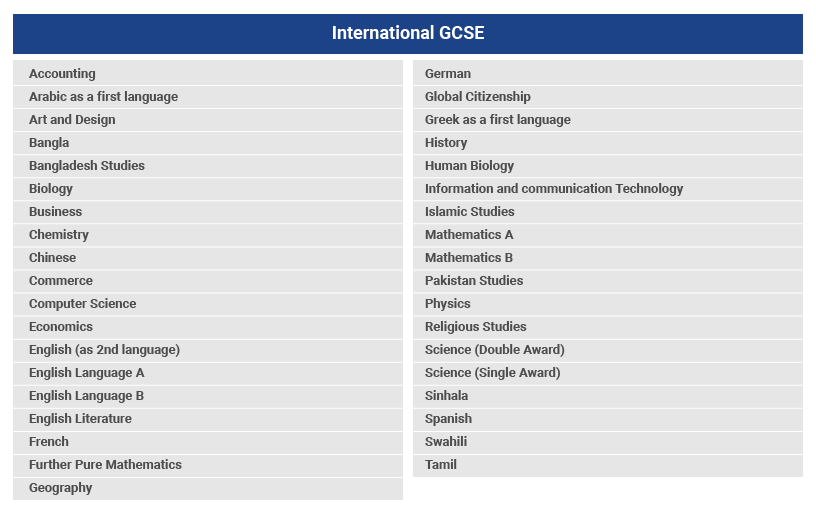
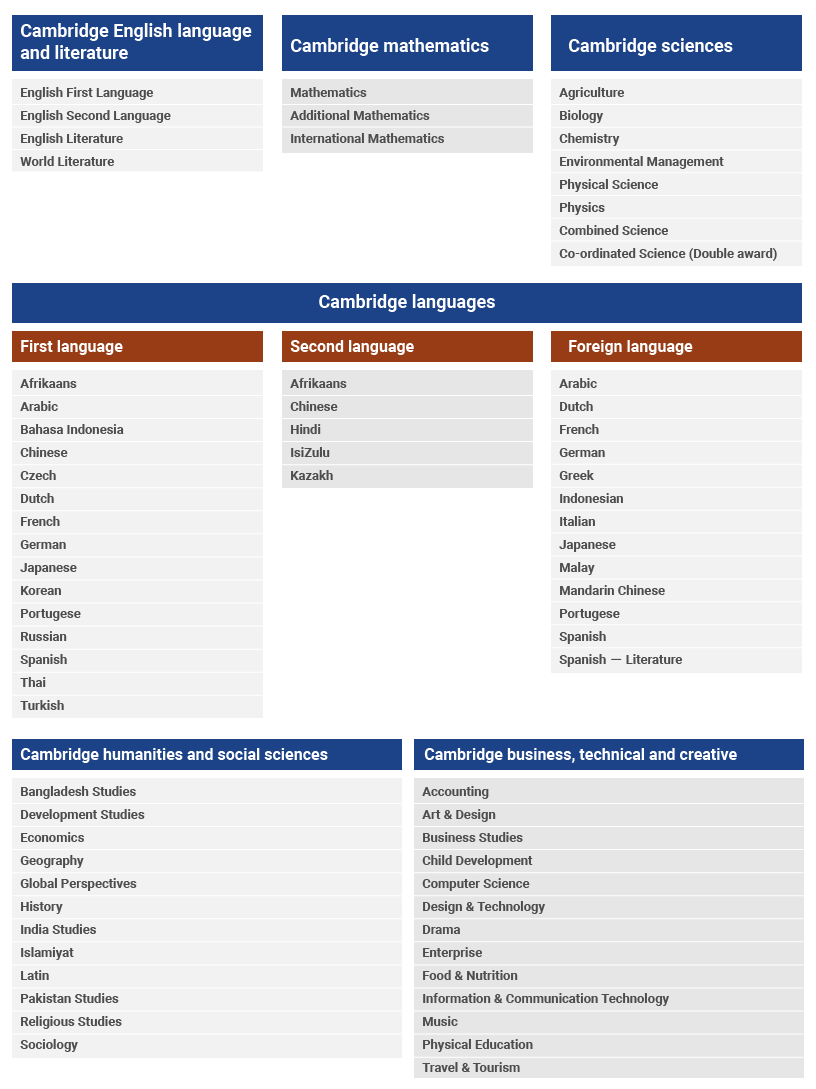
Cambridge IGCSE offers more than 70 subjects. Students are required to take a minimum of 5 or maximum of 14 subjects. The core subjects are English, Mathematics and Sciences. Students can also choose other subjects ranging from Social Sciences (commonly Accounting, Business Studies, Economics, Sociology) to Arts & Technology (commonly Computer Studies, Information & Communication Technology (ICT), Art & Design).
Student is awarded with one IGCSE certificate on each subject. For example, you will obtain 5 IGCSE certificates, if you take 5 subjects. Each school decides upon the number of compulsory subjects differently. However, a private candidate may decides based on individual preference.
Edexcel iGCSE curricula are well-established, stable and based on current international audience requirements. Besides that, they have more extensive and wide range of topics that are prerequisite knowledge prior to International A Level studies.
Example topics and chapters that are available in Edexcel iGCSE, but not in Cambridge IGCSE:
Cambridge IGCSE curricula are regularly updated and extended on a yearly or every 2-year basis. Therefore, this has become a great challenge for learners, parents and teachers to catch up with the constant changes.
Example incident:
A teacher in a private school in the UK was not aware of the change of syllabus for English First Language. We managed to assist her with the new exam syllabus just 2 months prior to the exams.
In view of the constant change of Cambridge IGCSE syllabus, here at Skolatis, we have developed a system to keep updating our course material so that candidates are learning the right exam syllabus. Parents can have peace of mind that their children are learning the right syllabus.
Cambridge IGCSE Curriculum is divided into 6 main subject groups. Each group contains several subjects which learners can choose from, in order to fulfil the minimum required subjects.
IGCSE (International General Certificate of Secondary Education) and GCSE (General Certificate of Secondary Education) are both qualifications that students in the United Kingdom and many other countries can earn, typically during their secondary education.
The main difference between IGCSE and GCSE lies in their geographic scope, curriculum, assessment methods, recognition, and flexibility. IGCSE is more internationally focused and flexible, while GCSE is primarily used in the UK and follows the UK national curriculum. Therefore, students and parents should consider these differences when choosing the most suitable qualification for their educational goals and circumstances.
GCSEs are primarily taken in the United Kingdom, including England, Wales, and Northern Ireland. However, in Scotland, a different system of qualifications is used.
IGCSEs are designed for international students and are offered by Edexcel and CIE. They are not limited to the UK and are used in many countries as an international qualification.
GCSEs follow the national curriculum of the United Kingdom. The relevant examination boards (for example AQA, OCR, etc.) in each of the UK nations determine the content and assessment methods.
IGCSEs do not necessarily follow the UK national curriculum. They often have a more global perspective and can be more flexible in terms of the subjects and content offered.
GCSEs in the UK are assessed through a combination of coursework (controlled assessments) and final exams. The grading system for GCSEs uses letter grades (A*, A, B, C, etc.).
IGCSEs typically rely more heavily on final exams, with limited or no coursework. The grading system for IGCSEs may use letter grades or a numerical scale.
GCSEs are widely recognised within the United Kingdom and are the standard qualification for students in the UK education system.
IGCSEs are recognized globally and may be more suitable for students who plan to study abroad or want to have their qualifications recognized in multiple countries.
GCSEs offer less flexibility in terms of subject choices and the content of the qualifications. Students typically follow a prescribed set of subjects.
IGCSEs often offer more flexibility in subject choices, allowing students to tailor their education to their interests and needs.
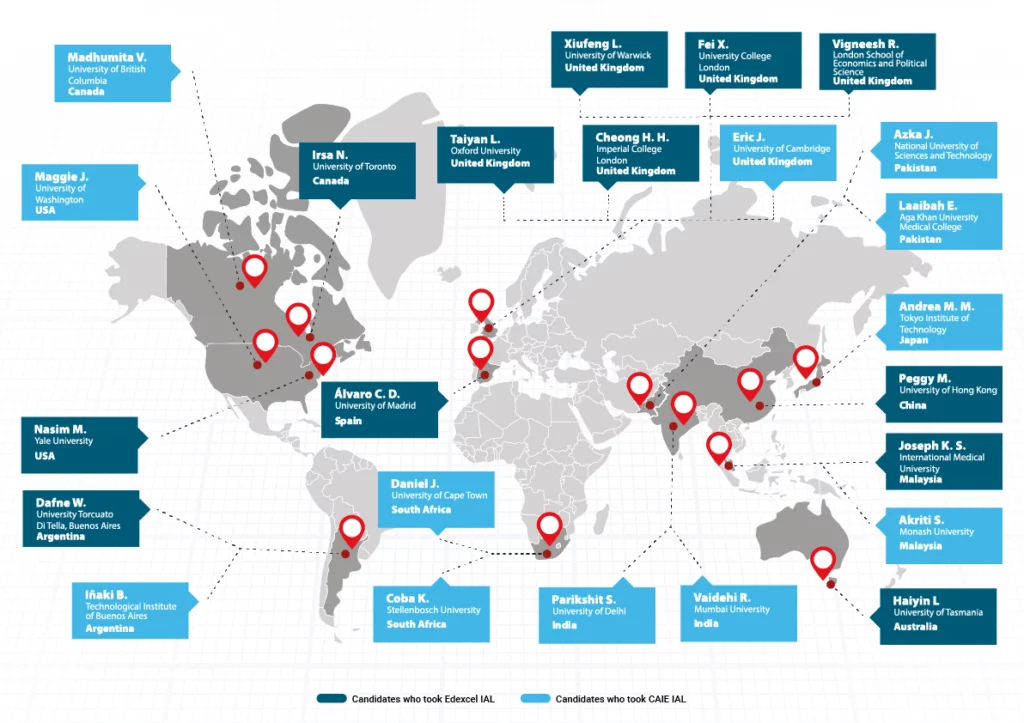
Universities and employers worldwide widely recognise and accept Edexcel IGCSE and Cambridge IGCSE qualifications.
Here are some examples international learners’ admissions into top universities globally.

Edexcel IGCSEs typically include written examinations, coursework, and practical assessments. The weightage of these components may vary depending on the subject.
Cambridge IGCSEs primarily rely on written examinations, with limited coursework and practical components. Assessment methods can vary by subject.
Edexcel IGCSE exams typically occur in January and June, standardised globally. Starting from November 2023, Edexcel has introduced the November series, replacing the January series. January 2023 was the last January series for Edexcel IGCSE. Therefore, from year 2024 onwards, Edexcel IGCSE is taking place in May/June and October/November.
Please refer to Edexcel IGCSE exam timetable and exam registration key dates for more information.
Cambridge IGCSE exams usually take place in May/June and October/November. With exceptional cases of March series for India, Romania and some schools in the Middle East.
Please refer to Cambridge IGCSE exam timetable and exam registration key dates for more information.
Note:
Although IGCSE and O Level are equivalent qualifications grade for grade, they are two different qualifications. IGCSE syllabus meets international standards while O Levels syllabus meets specific local needs in each country. Other notable differences are the grading scale, assessment techniques, and coursework options.
| IGCSE | O Level | |
| Grading | Grades are awarded from A* (highest grade) to G (lowest) | Grades are awarded from A* to E |
| Assessment techniques | Tests oral and practical skills | Focuses on writing and reading skills in language subjects Restricted practical test options in sciences |
| Coursework options | Available in many syllabuses | Fewer coursework options |
* If you need help in choosing between IGCSE and O Level, just leave us a question at the comment box below. We are more than happy to guide you.
Our internationally loved exam model answers had helped thousands of students in scoring A/A*. Schools and teachers worldwide have used these resources to aid in their teachings. Learn what an A* answer like, copy the style and score A* in your exam.
Our word-renowned IGCSE and AS/A Level courses had produced more than 1100 A/A* scorers worldwide. They are suitable for schooled or home-schooled candidates, and as full course or revision course.
We have the most complete past exam papers library on earth (no kidding!). Choose your exam board and download everything with one click.
Get the latest exam syllabus and plan your study accordingly.
Find out the exam registration and results released key dates for IGCSE and AS/A Level.
Check your administrative zone, the exam dates and time. For both IGCSE and AS/A Level.
Find and locate the nearest exam centre for your location.
Please kindly read the IGCSE FAQs here.
Note: CIE (Cambridge International Examination board) has its name changed to CAIE (Cambridge Assessment International Education) since October 2017.
In October 2023, CAIE updated its name, logo, look, and messaging. Cambridge International Education is the new name of the awarding body of Cambridge University Press & Assessment. This name will be used on materials related to administering exams and awarding qualifications.


Amal Elsayed
Kuwait

Understanding your Cambridge International exam results can often feel like decoding a complex language. While your final letter grade (A*,

If you are wondering what is A level, it is one of the most recognised pre-university pathways in the world,

Preparing for your IGCSE English as a Second Language (ESL) exam can feel daunting. You are not just learning grammar

Choosing the right educational pathway for your child is one of the most significant decisions a family can make. In
2,343 responses
Hi! My name is Victoria and I am from Argentina. In a few months I’ll be sitting for IGCSE First Language Spanish. As we don’t actually have any specified course to prepare the exam, I was wondering if you have any advise or tips for me to score the highest. Moreover, is there any online course or something that I really need to know?
Thank you for your time!
Hi Victoria,
As much as we want to help you, but we do not offer IGCSE Spanish First Language for this term. So sorry about that.
What we could suggest is:
1. Download the IGCSE Spanish First Language syllabus HERE.
2. Get the past exam papers here:
https://www.skolatis.com/cambridge-igcse-past-exam-papers/
3. Understand what are the objectives of the test, and how the exam paper is designed in corresponding to the objectives.
We haven’t come across any IGCSE Spanish First Language online course so far.
Hope the above could help you.
Thank you very much! The links have been really useful. I’ve got another doubt. I’m having trouble with the theorical paper (paper 1) of ICT. Do you have any advice?
Hi Victoria,
What kind of trouble do you have with the Paper 1 of ICT?
Could you please tell me the study pattern for igcse chemistry
I know everything but I am not able to write the answer
Hi Bharat,
Yes, we are showing candidates exactly how to answer question papers in our paid programme.
Please click here for details:
https://www.skolatis.com/igcse-private-and-online-tutoring/
Note, the closing date for registration is this Friday, September 12. So, hurry up and sign up before its door closes.
One of my friend got a Q for her IGCSE Biology, what does that mean?
Hi Phearnique,
Grade Q is the lowest grade in IGCSE grading. Please see above article for IGCSE grading table.
Hi admin,
In reply to your question.
I got an A for economics, but I am aiming for an A*, so that I will get straight A*.
By the way, I am aiming to study on economics (unlucky) in either LSE, Oxbridge, Harvard or MIT.
I have heard that they have high entry requirements, so I would probably need better grades to gain an edge (Not sure if I am right).
Hi Edward,
First of all, we strongly suggest you to “fix” your mind on what you consider as “lucky”. If you think studying Economics (or studying in LSE, Oxbridge, Harvard, MIT) is “unlucky”, we would suggest you not even consider to apply it.
What your mind is thinking and how you feel, will be what you will see in your reality. Unlucky = won’t get it.
You have achieved excellent result (a round applause for you from us IGCSE Team)! Perhaps be content (and grateful) on what you already have right now, go and fix your mind on what you think and feel is “lucky” to study. Then proceed from there.
All the quality universities do require excellent result as entry requirement. The only thing you must check is, if those universities do accept excellent IGCSE as entry requirement. Cause normal entry requirement for university is either A-Level, Pre-U or any equivalent.
If you feel by remarking your paper will grant you an A* (and you will sleep better at night), by all means go ahead. Mean while, you can also proceed to apply a place at the university of your choice. Well, after you have fixed your mind on what is “lucky” to study 🙂
My fault. I didn’t make myself clear. What I meant to say is that it’s unlucky for me to get a grade below my expectations for a subject that I am interested in most. I am sorry if I seems to be too fastidious about my economics grade, but the thing is, this grade meant a lot for me, I have been concentrating a lot of efforts on economics for IGCSE, and by no means am I being ungrateful for the results I have got. By the way, having an opportunity to study in prestigious universities like LSE, Oxbridge, Harvard, MIT is definitely an honour for me… I’m sorry if I didn’t make myself clear.
I’m sorry, I didn’t make myself clear. What I meant about unlucky is that it’s unlucky for me to get a grade below my expectation for a subject that I am interested in most. I am sorry if I sounded too fastidious about my grade, but the thing is, this grade meant a lot for me, I have been putting a lot into economics for IGCSE, and by no means am I being ungrateful of my results. By the way, having an opportunity to study in prestigious universities like LSE, Oxbridge, MIT, Havard etc. is definitely an honour for me… I’m sorry if I didn’t make myself clear.
Hi Edward,
No worries about that… Miss understanding does happen all the time in our daily lives. Every human being understands things differently. 🙂
We still would suggest you to go ahead to apply for remark if you feel you would get better grade after that. Follow your feeling. But at the same time you can start applying to universities. Check what we suggest earlier.
If you need anything else, just drop us a line here.
Hello
I have recently got my IGCSE grade and they were within A-C.My aunts and grandmother lives in US and my mom only allowing me to go to only US for my further studies so studying grade 12 in American school and taking SAT will be fine to get in reputed university with a good SAT score ?
Thank you
Hi Zahaan,
If you’re ‘only’ going to study in US, then SAT would be good. Any reputable universities require very high score in all kind of entry examination, e.g: A-Level, Pre-U, SAT, IB, etc etc…
I am just asking if getting my grades remarked will affect my university application in any ways? Like, will the university be able to know that my grades are remarked? If so, will they discriminate my grade. If I am sure that I can get better grades after remark, should I remark my paper considering the fact that the university might discriminate my result?
Hi Edward,
The university won’t ‘discriminate’ the result. Results are just facts and numbers. Asking for remark won’t affect your application. Your application will be based on your current result. Nevertheless, once you have gotten your new result, you have to inform the university with the new one.
Thanks for the reply, I am worried because I heard that some university won’t accept retakes. So if worst come to worst, should I retake my exam?
Hello Edward,
As we do not know which subjects you want to retake, what are the grades you obtained currently, what do you want to apply in the university, it is hard for us to advise you whether to retake or not.
If you could let us know the above, we would be happy to share our suggestions to you.
So the university will accept the fact that I am shifting to American syllabus for grade 12 ?
Hello Zahaan,
Universities will look at your last qualification as entry requirement. They can be A-Level, Pre-U, SAT, IB etc etc… as long as you fulfil the entry requirement for the course that you apply.