
Percentage Uniform Marks (PUM) Explained: A Comprehensive Guide
Understanding your Cambridge International exam results can often feel like decoding a complex language. While your final letter grade (A*,



Announcement:
Cambridge International Education no longer be an Ofqual-recognised awarding organisation from December 20, 2024.
O-Level is the abbreviation of Ordinary Level. It is one of the two-part GCE (General Certificate of Education). The second part of GCE is Advanced Level (A-Level), which students enter after completing O-Level.
O-Level is the final certification for secondary school, to be taken at fifth form or year 11 at approximately age 17 (or age group 14-16). Students that have completed O-Level are considered to have completed formal education. They can further their studies to A-Level (at their schools’ sixth form or private colleges), Foundation Courses or diploma courses, or simply leaving school.
There are a few exam bodies offer O-Level, for example CAIE board, American Council for Higher Education and Edexcel International. Though schools in the UK had replaced O-Level with GCSE in 1988, it is still used in many Commonwealth countries, such as Bangladesh, Brunei, Malaysia, Malta, Mauritius, Pakistan, Singapore, Sri Lanka and also in Trinidad and Tobago. (Some schools in the UK have reverted back to exams based on O-Level at the later stage.)
O-levels are predominantly exam-based. Therefore, this is advantages for students in part-time or evening education. Some commentators criticised this mainly exam-based approach as offering only partial proof of the student’s overall ability in comparison with other methods (e.g., coursework-based assessment). There was no summative “school certificate”: each subject was a separate O-level in its own right.
(Below are the information for O Level from the CAIE exam board only.)
Cambridge O Level is an internationally recognised qualification equivalent to Cambridge IGCSE and the UK GCSE. It provides learners with excellent preparation for academic progression to Cambridge Advanced as well as other progression routes.
Cambridge O Levels has been designed especially for an international audience. They are sensitive to the needs of different countries and for learners whose first language may not be English. The curriculum also enables teaching to be placed in a localised context, making it relevant wherever you teach it.
In some parts of the world, schools use Cambridge O Level as an international alternative to the local national examination.
You can choose from more than 40 subjects in any combination to provide the building blocks to create your own curriculum. Students normally take 7-9 subjects in the O-Level exam, with maximum allowable 14 subjects.

Many schools allocate a total of about 130 hours for each Cambridge O Level subject, but how much time a school devotes to each subject will depend on a variety of factors. Though Cambridge sets the syllabus, but the school decides on the method of teaching. Candidates must enter for Cambridge O Levels through a registered school or exam centre. Your school or exam centre will be able to give you more details about how candidates work towards these assessments.
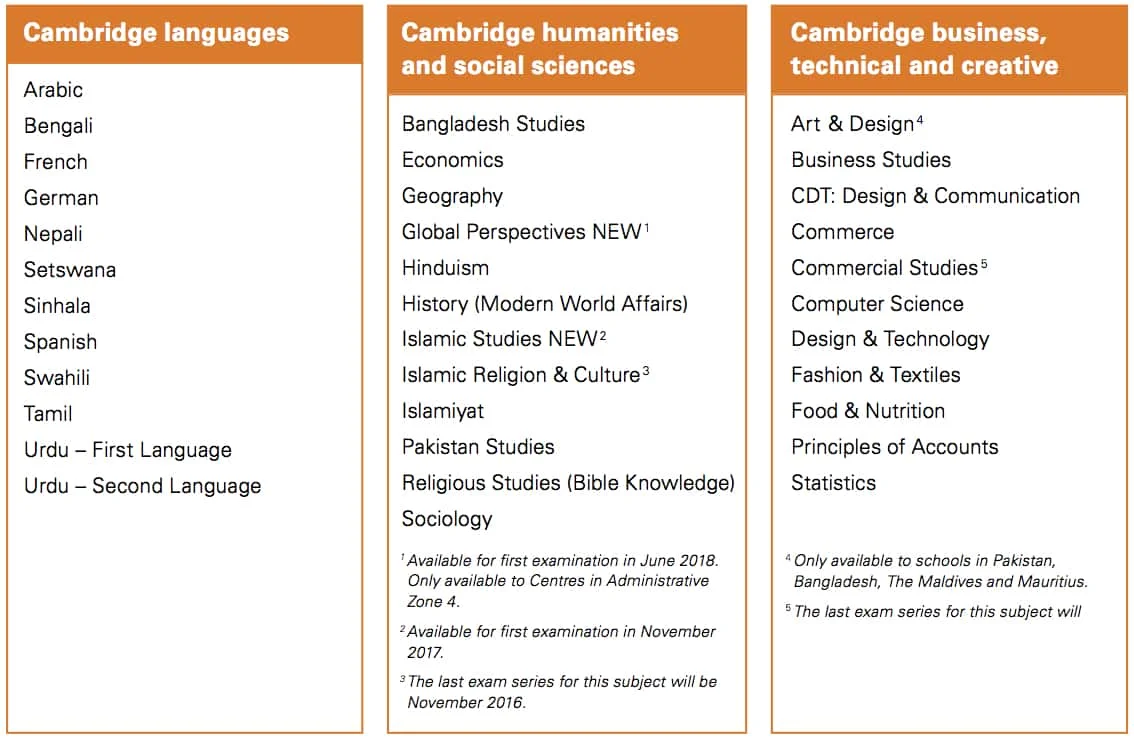
At school, more able candidates may study six or seven subjects at Cambridge O Level, but less able candidates may have a much more modest programme. In order to follow a broad and balanced curriculum, most candidates take courses from each of the five Cambridge O Level groups (Languages; Humanities and Social Sciences; Sciences; Mathematics; and Business, Creative, Technical and Vocational). However, it is also possible to study individual Cambridge O Level subjects if this better suits the candidate’s needs.
Cambridge O Level courses usually take two years to complete and exams are taken at the end of that period.
Assessment takes place at the end of the course and includes written, practical and oral assessment. This broadens opportunities for students to demonstrate their learning, particularly when their first language is not English.
Grades are benchmarked using six internationally recognised grades, from A* to E. Therefore, it has clear guidelines to explain the standard of achievement.
Grade A* is awarded for the highest level of achievement, and grade E indicates minimum satisfactory performance. Grade U (Ungraded) is commonly regarded as fail.
Cambridge O Level examination series occur twice a year, in June and November. Results release is in August and January.
Many universities worldwide require a combination of Cambridge International A Levels and Cambridge O Levels to meet their entry requirements. Leading US and Canadian universities require Cambridge International AS & A Levels, but some US and Canadian colleges and universities will accept learners with five Cambridge O Levels at grade C
or above.
In the UK, Cambridge O Level is accepted as equivalent to the GCSE. Many UK universities look at Cambridge O Level grades, as well as predicted grades for Cambridge International A Level, when making admissions decisions.
Universities in many countries, including Canada and the USA, will admit students on the basis of their Cambridge O-Level performances alone. Grade C in Cambridge O-Level English Language satisfies the English proficiency requirements of many universities in the UK and other English-speaking countries.
Although IGCSE and O Level are equivalent qualifications grade for grade, they are two different qualifications. IGCSE sets international standards, on the other hand, O Level syllabus meets specific local needs in each country. Other notable differences are the grading scale, assessment techniques, and coursework options.
| IGCSE | O Level | |
| Grading | Grades are awarded from A* (highest grade) to G (lowest) | Grades are awarded from A* to E |
| Assessment techniques | Tests oral and practical skills | Focuses on writing and reading skills in language subjects Restricted practical test options in sciences |
| Coursework options | Available in many syllabuses | Fewer coursework options |
Our valuable A* resources had produced thousands of A* scorers around the world. Check them out below.
Our internationally loved exam model answers had helped thousands of students in scoring A/A*. Schools and teachers worldwide have used these resources to aid in their teachings. Learn what an A* answer like, copy the style and score A* in your exam.
Our word-renowned IGCSE and AS/A Level courses had produced more than 1100 A/A* scorers worldwide. They are suitable for schooled or home-schooled candidates, and as full course or revision course.
We have the most complete past exam papers library on earth (no kidding!). Choose your exam board and download everything with one click.
Get the latest exam syllabus and plan your study accordingly.
Find out the exam registration and results released key dates for IGCSE and AS/A Level.
Check your administrative zone, the exam dates and time. For both IGCSE and AS/A Level.
Find and locate the nearest exam centre for your location.
Please kindly read the O Level FAQs here.
Note: CIE (Cambridge International Examination board) has its name changed to CAIE (Cambridge Assessment International Education) since October 2017.
In October 2023, CAIE updated its name, logo, look, and messaging. Cambridge International Education is the new name of the awarding body of Cambridge University Press & Assessment. This name will be used on materials related to administering exams and awarding qualifications.
Note: All relevant info taken from CIE.


Akshaya S T
Singapore

Understanding your Cambridge International exam results can often feel like decoding a complex language. While your final letter grade (A*,

If you are wondering what is A level, it is one of the most recognised pre-university pathways in the world,

Preparing for your IGCSE English as a Second Language (ESL) exam can feel daunting. You are not just learning grammar

Choosing the right educational pathway for your child is one of the most significant decisions a family can make. In
572 responses
Hey, My younger brother is wanting to give O levels exams as a private candidate Humanities Subjects in ,. Can you please guide me what are the minimum number of subjects he will have to give in order to complete his O levels and be eligible to apply in international universities?
The universities in Pakistan have minimum requirement of 8 subjects in O levels including Urdu Pakistan Studies and Islamiat as compulsory subjects and 3 further subjects in A levels but as he wont be able to give urdu he wants to prepare for an international university and can you also guide me on IGCSE subjects as well and If there is any option in IGCSE exams for deaf students as my brother is deaf by birth and has a cochlear implant and uses written english as his mode of communication instead of sign language.
Thankyou
Hello Sarah,
Thank you for writing in.
University entry requirements are usually based on required subjects taken, not the number of subjects taken. As such, we strongly suggest that you check with the universities that your brother wishes to apply to, and get the confirmation on required subjects in accordance to what he would want to pursue for further studies. Furthermore, please kindly check with your school if the compulsory subjects of your country do not apply to him.
With regards to your brother’s needs, you may apply for Access Arrangements. We suggest that you start finding out the application process from now. Please read these articles for more information:
https://help.cambridgeinternational.org/hc/en-gb/articles/115004285225-What-are-Access-Arrangements-and-how-do-I-apply-
https://www.cambridgeinternational.org/exam-administration/cambridge-exams-officers-guide/phase-1-preparation/access-arrangements/
https://www.cambridgeinternational.org/Images/561646-cambridge-handbook-2020-international-version.pdf
If you have further questions, feel free to write to us again. Thank you.
hi! i would like to inquire what’s the difference between 0500 and 1123 English and why people choose each
Hello Sharvendra,
These two subjects are from different exam boards. English – First Language (0500) is under IGCSE while English Language (1123) is under O Level.
If your plan is flexible, we would suggest you to take IGCSE instead of O Level. If your future work requires an international environment, we feel IGCSE would be better for you. O Level is good as well, just the syllabus is more localised.
We hope this helps.
Hi , I am from Pakistan, a student of beacon house 8th grade
What is difference between Cambridge O Level and Cambridge IGSCE studies ?
Which to choose , my school is asking me to choose one of them ?
Hello Ibrar,
IGCSE set internationally recognised standards while O-level were developed to meet specific local needs in each country. Furthermore, IGCSE uses a variety of assessment techniques to test oral and practical skills, initiative and problem-solving and application of skills, knowledge and understanding. A coursework option is available in many syllabuses, allowing schools an element of personal choice and giving teachers the chance to share in the process of assessment. On the other hand, O-level offers fewer coursework options than IGCSE. The focus of O-level languages is on writing and reading skills and there are more restricted practical test options in O-level sciences.
If your plan is flexible, we would suggest you to take IGCSE instead of O Level. If your future work requires international environment, we feel IGCSE would be better for you. O Level is good as well, just the syllabus is more localised.
You might want to check out our A* subscription courses where we provide A/A* guarantee for candidates who follow our programme diligently. To understand how it works, kindly read this page: https://www.skolatis.com/cambridge-igcse-revision-courses/
If you have further questions, feel free to write to us again. Thank you.
What textbooks do O-levelk students use? is it the same for every school?
Hello Brenda,
Typically, it is the schools that choose textbooks that are suitable for O-level syllabus. If you are looking for O-level textbooks, we suggest that you search on Amazon UK or your local bookstore for suitable reference books.
Hello.
Are the O-Level and IGCSE grades the same? i.e. if a course requires a O-Level English D7 does that mean a D in English IGCSE?
Thanks
Hello Cat,
Although O-Level and IGCSE are equivalent qualifications and have similar syllabus, they have different question formats and grading schemes. As such, it does not directly mean that a D grade in O-Level is the same as a D grade in IGCSE. We suggest that you confirm the entry requirements with your chosen college/university.